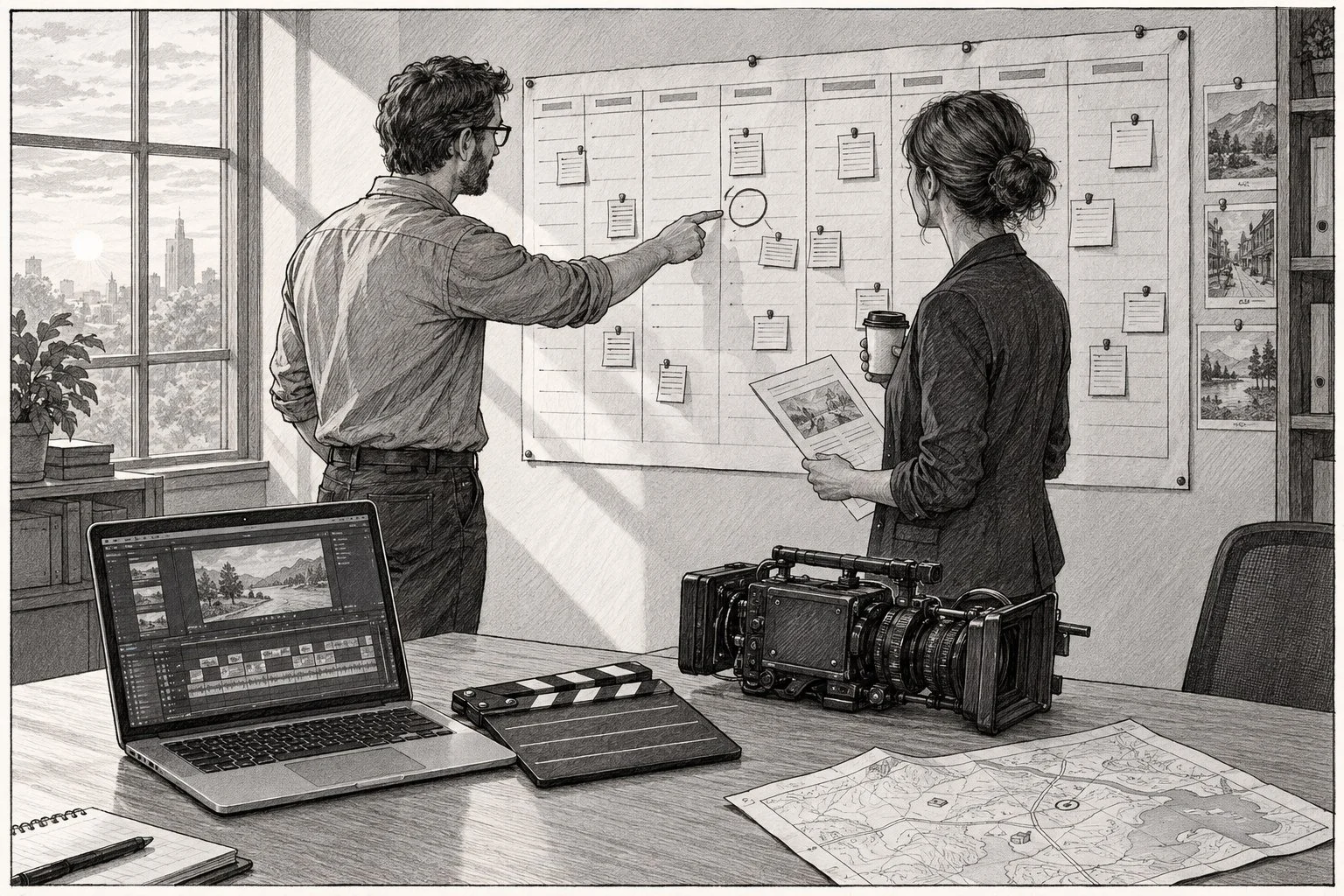
AI-generated storyboard illustration; a conceptual scene, not a client-production still.
For a professionally produced commercial video with a defined concept, one or two shoot days, and a handful of deliverables, plan on roughly six to ten weeks from signed scope to final files. Simpler projects with existing locations and no casting can move faster. Projects with talent, multiple locations, drone work in controlled airspace, or a long approval chain take longer. The shoot itself is usually the shortest part. What actually sets the schedule is how quickly decisions get made before the camera rolls and how many review rounds happen after it.
Below is a phase-by-phase breakdown, the items that quietly control the critical path, a backward-planning worksheet you can start from your launch date, and what really happens when a project gets rushed.
The short answer, phase by phase
These are common planning ranges for a commercial-scale project, not promises. Treat them as a starting point to pressure-test against your own approval process.
Brief, scope, and agreement: 1–2 weeks. Clarifying the objective, audience, deliverables, budget range, and usage. The calendar usually slips here because of internal sign-offs and contract review, not creative work.
Creative development: 1–3 weeks. Treatment or concept, script or interview outline, and the first look at tone and references. One concept presented with clear reasoning moves faster than three options that invite a committee vote.
Pre-production: 2–4 weeks. Locations, casting, crew, equipment, permits, insurance certificates, wardrobe and props, shot list, schedule, and a weather or contingency plan. This is where the shoot day is won or lost.
Production: 1–3 days for most commercial projects. Sometimes more for multi-location campaigns. A single shoot day is the most visible milestone, but it is the least flexible one.
Post-production: 2–5 weeks. Editing, review rounds, color, sound design and mix, music licensing, graphics, captions, and versioning into every required length and aspect ratio.
Delivery and handoff: a few days. Final exports, file checks, and archiving of project files and source footage.
Add those up and a typical project lands between six and ten weeks. Most of the variation comes from two places: how long decisions take before the shoot, and how many rounds of notes happen after it.
What actually sets the critical path
Production schedules are less about effort and more about dependencies. A few items can't be rushed by adding people, and they are worth knowing before you set a launch date.
Decisions and approvals
Every approval gate (concept, script, casting, locations, rough cut, final cut) is a place where a week can disappear. The fix isn't to skip gates. It's to name one decision-maker for each, agree on turnaround times up front (for example, notes within two business days), and schedule the review meetings when the project starts rather than when the cut is ready.
Talent and casting
Casting needs time for breakdowns, auditions or self-tapes, callbacks, holds, and approvals. With union talent, the calendar has a second dimension that buyers often miss. Under the 2025 SAG-AFTRA Commercials Contract, a commercial's maximum period of use is 24 months, beginning 10 working days after the first day of on-camera production, and holding fees are due 13 weeks from that first day, according to SAG-AFTRA's contract FAQ. In practice, that means shooting months before a launch can spend part of your usage window before the ad ever runs. Confirm the specifics with your production company or a talent payroll provider, but build the launch date and the shoot date together rather than separately.
Locations and permits
Private locations need an agreement and sometimes a scout, a site visit for power and parking, and a backup. Public locations may need a permit. In Dallas, the Dallas Film Commission asks for applications at least three business days ahead, or five for more complex shoots, and requires a certificate of insurance before a permit is issued. Those lead times are short, but they assume the location, date, and plan are already settled. The real lead time is the decision, not the paperwork.
Drone work
Much of Dallas–Fort Worth sits in controlled airspace around DFW, Love Field, and several other airports. The FAA's LAANC system can approve many requests in near-real time, but flights above the altitude ceiling on the local facility map require a "further coordination" request that is reviewed manually and can be submitted up to 90 days in advance. If aerials matter to the concept, raise them in pre-production, not the week of the shoot.
Weather and daylight
Outdoor projects depend on season, sunrise and sunset, heat, and backup dates. Reserving a weather day doesn't add weeks, but booking crew and talent on hold for one does require planning ahead. For a fuller look at contingencies, see why you should ask for a weather plan before hiring.
Music, graphics, and versions
Licensed music clearance, custom animation, and a long deliverables list all extend post-production. Every additional cutdown and aspect ratio is a separate edit to build and review. Deciding those deliverables before the shoot, as covered in our guide to planning cutdowns and vertical versions, keeps them from turning into a second post schedule.
Plan backward from your launch date
The most reliable way to set a production schedule is to start at the date the video must be live and work backward. Here's a worksheet for a hypothetical project: one 60-second hero video, three short cutdowns, and two vertical versions, shot over two days at two private locations with a small cast.
Launch date (Week 0). Final files uploaded, captioned, and tested on every platform, with ad accounts approved.
Final delivery (Week 1 before launch). Leave a week for upload, ad review, and last-minute platform specs. Ad platforms and internal legal review can each take days.
Final cut approval (Weeks 2–3 before launch). Color, mix, captions, and versions follow the approved cut, not the other way around.
Rough cut and revisions (Weeks 3–5 before launch). Budget two structured review rounds. Each round needs time for consolidated notes plus time for the editor to address them.
Shoot days (Week 6 before launch). Lock the dates once locations, talent, and crew are confirmed, and hold a weather day if the shoot is outdoors.
Pre-production (Weeks 7–9 before launch). Casting, locations, permits, insurance certificates, shot list, and schedule.
Creative approval (Week 10 before launch). Concept and script or interview outline signed off.
Kickoff and contract (Week 11 before launch). Brief confirmed, scope and usage agreed, deposit paid.
If your calendar doesn't fit, the worksheet shows you exactly where to make a tradeoff instead of compressing everything evenly.
What happens when you rush
Rush schedules are possible. Production companies handle them regularly. But the time has to come from somewhere, and it's better to choose where than to let it happen by accident.
What compresses reasonably well: creative development (if the brief is very clear), crew and equipment booking in a market with depth, and editing, if review rounds are fast and consolidated.
What resists compression: casting with callbacks, permits for public or complex locations, drone authorizations that require manual review, licensed music, and approvals that involve legal or multiple executives.
What rushing usually costs: fewer location options, limited casting choices, overtime or premium rates, less coverage on the day because the shot list wasn't fully tested, and less time to fix issues in post. Sometimes the right answer is a smaller first deliverable on the launch date, followed by the full set of versions a week or two later.
Questions to ask about schedule before you sign
These questions help a marketing team understand whether a production company's timeline is realistic:
What are the key decision dates on our side, and what happens to the shoot if we miss one?
How many review rounds are included, and what is the expected turnaround for each?
Which items in this project have the longest lead times: talent, locations, permits, aerials, music?
If the shoot is outdoors, how are weather days handled, and what does a hold cost?
What would you cut or simplify first if we had to deliver two weeks earlier?
When will we receive final files, and in which versions?
A strong production company will answer with specific dates and dependencies, not a single delivery date. For more vetting questions, see what to ask before hiring a video production company. For a phase-by-phase look at who handles what, see what a commercial video production company actually does.
The bottom line
A commercial video timeline is mostly a decision timeline. The camera rolls for a day or two, but the weeks around it depend on how clearly the brief is written, how quickly approvals happen, and which long-lead items (talent, locations, aerials, music, versions) are identified early. Start from your launch date, plan backward, name the decision-makers, and build in two review rounds and a buffer. That way the schedule protects the work instead of squeezing it.