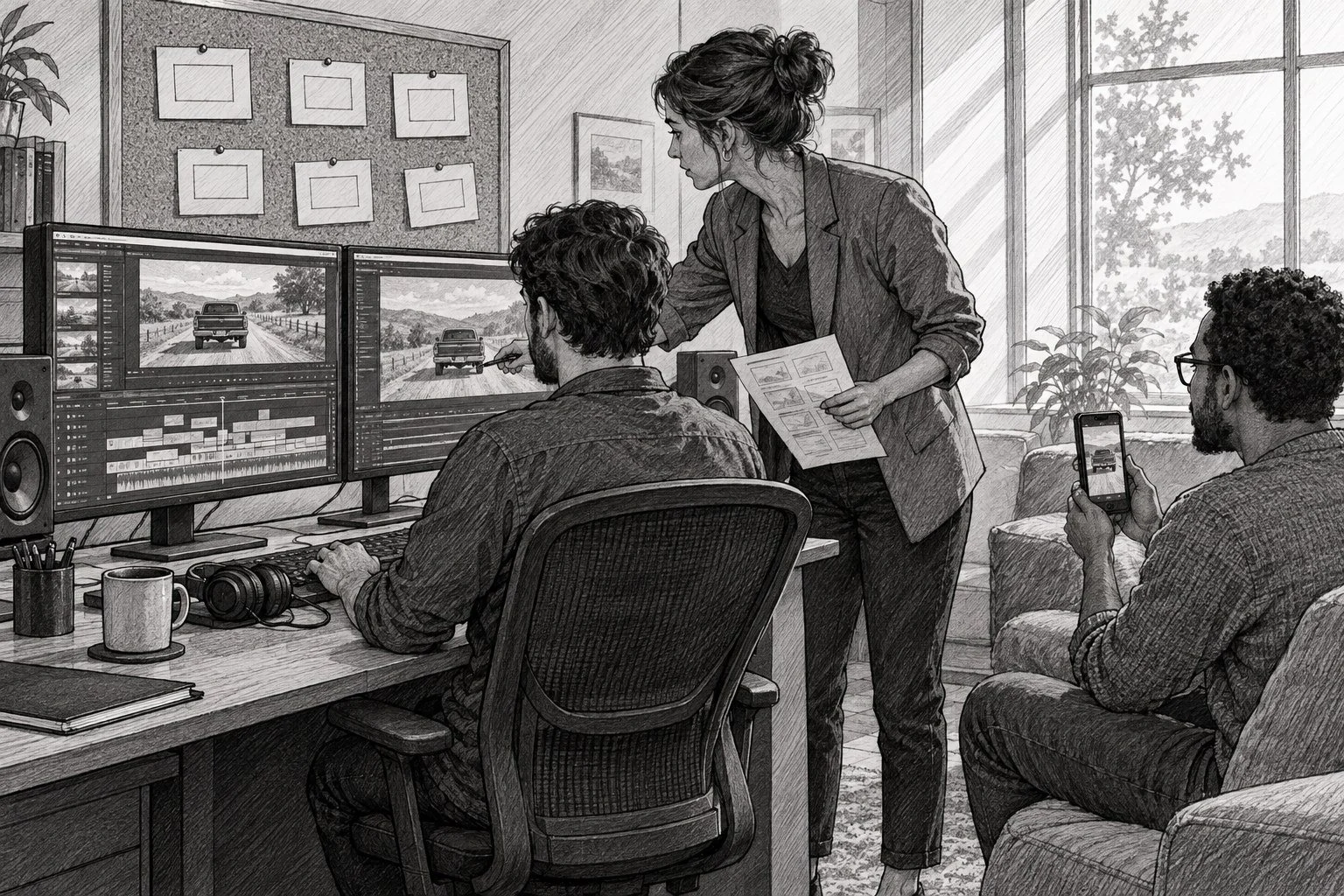
AI-generated storyboard illustration; a conceptual scene, not a client-production still.
Review each version of a video for the decisions that version is built to settle. A rough cut is for story and structure. A fine cut is for pacing, performances, on-screen words, and music direction. The final is for technical and compliance checks. Most wasted revision rounds come from mixing those up: polishing notes on a cut whose story isn't settled yet, or story notes on a cut that is already locked and finished.
This guide walks through what to look for at each stage, what to deliberately ignore, how to set up a review so notes stay useful, and a one-page checklist your team can reuse on every project.
Why the stage of the cut matters
Early cuts are unfinished on purpose. Editors often work with lightweight copies of the footage (proxies) so the edit moves quickly, and they leave the expensive finishing work for later. In a typical rough or fine cut you may see:
Ungraded color. Shots won't match yet, and skin tones or product colors can look off.
Rough audio. Levels jump, room noise is audible, and there may be no sound design.
Temp music. A placeholder track that sets a mood but may not be licensed or even licensable.
Placeholder graphics. Simple white text where finished titles, lower thirds, or animation will go.
None of that is worth a note yet, and every note spent on it is a note not spent on the story. A simple fix: ask your editor or producer to send a short "what's temporary in this cut" list with each version. It takes them two minutes and saves everyone a round.
One item does deserve early attention: temp music. Teams often fall in love with a temp track over several weeks of reviews, then learn it would cost far more than the budget allows or can't be cleared at all. Editors sometimes call this "temp love." If music matters to your brand, ask for temp tracks from a library you can actually license, or agree on licensed candidates before the fine cut.
Before you press play: set up the review
A good review starts before anyone watches.
Name one person who consolidates notes. Several stakeholders can watch, but one person reconciles conflicting comments and sends a single, prioritized set. Our earlier piece on giving clear, constructive feedback on a video edit covers how to phrase notes so an editor can act on them.
Reread the brief first. Every reviewer should know the audience, the one thing viewers should take away, and where the video will run. Notes that trace back to the brief are decisions. Notes that don't are opinions.
Watch it the way your audience will. If it's a vertical social ad, watch it on a phone, held vertically, with the sound off first, the way many people scroll. If it's a website hero film, watch it on a laptop. A cut approved only on a large monitor in a quiet room can fall apart on a phone speaker.
Use timecoded comments in one place. Review platforms let reviewers pin notes to an exact frame. One shared thread beats five email chains and a hallway conversation.
Agree on turnaround both ways. Decide up front how many business days your team has to return notes and how long the editor has to address them. Review rounds are one of the biggest swing factors in a commercial video production timeline.
Rough cut: judge the story
The rough cut is the most important review and the cheapest place to make big changes. The question is simple: does this tell the right story to the right audience?
What to check
The opening. Do the first few seconds give your audience a reason to keep watching, especially in a feed?
The message. After one viewing, can someone who hasn't read the brief say what the video is about?
The structure. Is the order right? Are the strongest moments or interview lines in the right places, or buried in the middle?
What's missing. Required product moments, key proof points, a call to action, or anything your legal team says must appear.
What doesn't belong. Lines or scenes that are true but off-message, or that a stakeholder will object to later.
Runtime. Is the cut in the neighborhood of the target length? A rough cut can run long, but not twice the target.
What to hold for later
Color, audio levels, music specifics, graphics styling, frame-level trims, and small continuity slips. If you notice them, keep a private list; most will disappear on their own as the edit is finished.
An editor's priority list worth borrowing
Walter Murch, the editor of Apocalypse Now and The English Patient, describes a "Rule of Six" in his book In the Blink of an Eye. When deciding where to cut, he weighs emotion first (51 percent), then story (23 percent), then rhythm (10 percent), with the remaining weight on where the viewer's eye is and on spatial continuity, as summarized by the Black List's Go Into The Story. The percentages are deliberately playful, but the order is useful for a marketing review: ask first whether the cut makes you feel what your audience should feel, then whether the story is clear. A cut that does both survives small technical flaws. Polish can't rescue a cut that does neither.
Fine cut: judge pacing, performance, and words on screen
Once the story is approved, the fine cut tightens it. Structural changes here are possible but costly, so reserve them for genuine problems.
What to check
Pacing, section by section. Does any part drag or rush? Do the transitions between ideas feel deliberate?
Performances and takes. Is this the best read of each important line? Does every on-camera person come across the way they would want to?
Product accuracy. Correct model, current packaging, current logo, and features shown the way they actually work. This is easy to miss and expensive to fix after release.
Every word on screen. Spelling, names, titles, figures, and legal lines. Are supers on screen long enough to read once, comfortably?
Claims. Send the fine cut to legal or compliance now, not at final. Any claim that needs substantiation is easier to adjust before the finishing work is built around it.
Music direction. The final track, or a licensed candidate, should be in place so pacing is judged against the real music.
The short versions. If the master will be cut down into 15- and 6-second versions or vertical formats, check that the structure supports them. We cover that in planning cutdowns and vertical versions before the shoot.
Picture lock
Approving the fine cut usually means picture lock: the timing of every shot is final. After lock, the colorist, sound mixer, composer or music editor, and graphics artist all build their work to exact frames. A small change after lock, such as swapping one shot or trimming two seconds, can ripple through color, the mix, captions, graphics, and every cutdown. That's why production companies treat changes after lock as additional work. Lock only when you're confident, and make sure everyone who can veto the video has seen it first.
Final: run a technical and compliance check
The final review isn't about taste. It's a quality-control pass, and it's worth doing with a checklist.
Color. Shots match each other, skin tones look natural, and product and brand colors are accurate.
Sound. Dialogue is clear on a phone speaker and on good headphones. Music supports the voiceover rather than burying it. No pops, clicks, or abrupt cuts in the audio.
Loudness specs for TV. If a spot will air on broadcast or cable, regionally in Dallas–Fort Worth or anywhere else, it has to meet that outlet's delivery specification. The FCC's rules under the CALM Act require TV commercials to have the same average volume as the programs around them, measured using the ATSC A/85 recommended practice, according to the FCC's loud commercials guidance. Ask for each station's or network's spec early and confirm the mix was delivered to it.
Captions. For TV, the FCC's caption quality standards call for captions that are accurate, synchronous, complete, and properly placed, per the FCC's closed captioning guide. They're a sensible bar for online video as well: correct spelling and names, timed to the speech, and never covering important on-screen text.
Safe zones. On vertical platforms, captions, buttons, and profile info cover parts of the frame. Check that logos, supers, and calls to action sit clear of them on each platform.
Every version, start to finish. Watch every length and aspect ratio, not just the master. Look for flash frames, black frames, typos, wrong end cards, and audio that cuts off early.
File details. Correct file names, formats, frame rates, and any slates or delivery requirements your media buyer or station needs.
What counts as a review round
A round is one consolidated set of notes on one numbered version. Comments trickling in over a week from different people are still one round, but they're much harder for an editor to address cleanly. Number every version (v1, v2, v3), make sure notes reference the version they're about, and keep the review history in one place.
It also helps to know where a revision ends and a new direction begins. Tightening a section or swapping a shot is a revision; a different story or message is a change of scope. We go deeper on that line in our list of questions to ask before hiring a video production company.
A one-page review checklist
Copy this into your project folder and reuse it on every video.
Rough cut. Approve: story, message, structure, opening, what's included and excluded, approximate runtime. Hold for later: color, mix, music specifics, graphics styling, small trims.
Fine cut. Approve: pacing, takes, product accuracy, every on-screen word, legal and claims review, music direction, structure for cutdowns. Then: picture lock.
Final. Approve: color consistency, dialogue clarity, loudness and delivery specs, captions, safe zones, every version watched in full, file names and formats.
Every round: one consolidator, one numbered version, timecoded notes in one place, agreed turnaround, notes tied to the brief.
Questions to ask your production company about reviews
What will be temporary in each cut, and will you tell us with each version?
Which review platform will we use, and can our stakeholders comment on it directly?
How many rounds are included at each stage, and what turnaround do you expect from us?
When is picture lock, and how are changes after lock handled?
When will music be licensed, and are temp tracks drawn from music we can actually use?
Who runs final quality control, and to which delivery specs?
The bottom line
A good review process isn't about having a sharper eye than the editor. It's about asking each cut the right question at the right time: story first, then pacing and words, then technical checks. Set up the review before you watch, send one consolidated set of notes, protect picture lock, and run the final like a checklist. Your team will spend fewer rounds getting to a better video, and the people building it will spend their time on the work rather than on untangling notes.