Hiring an Outdoor Video Production Company? Ask for a Weather Plan
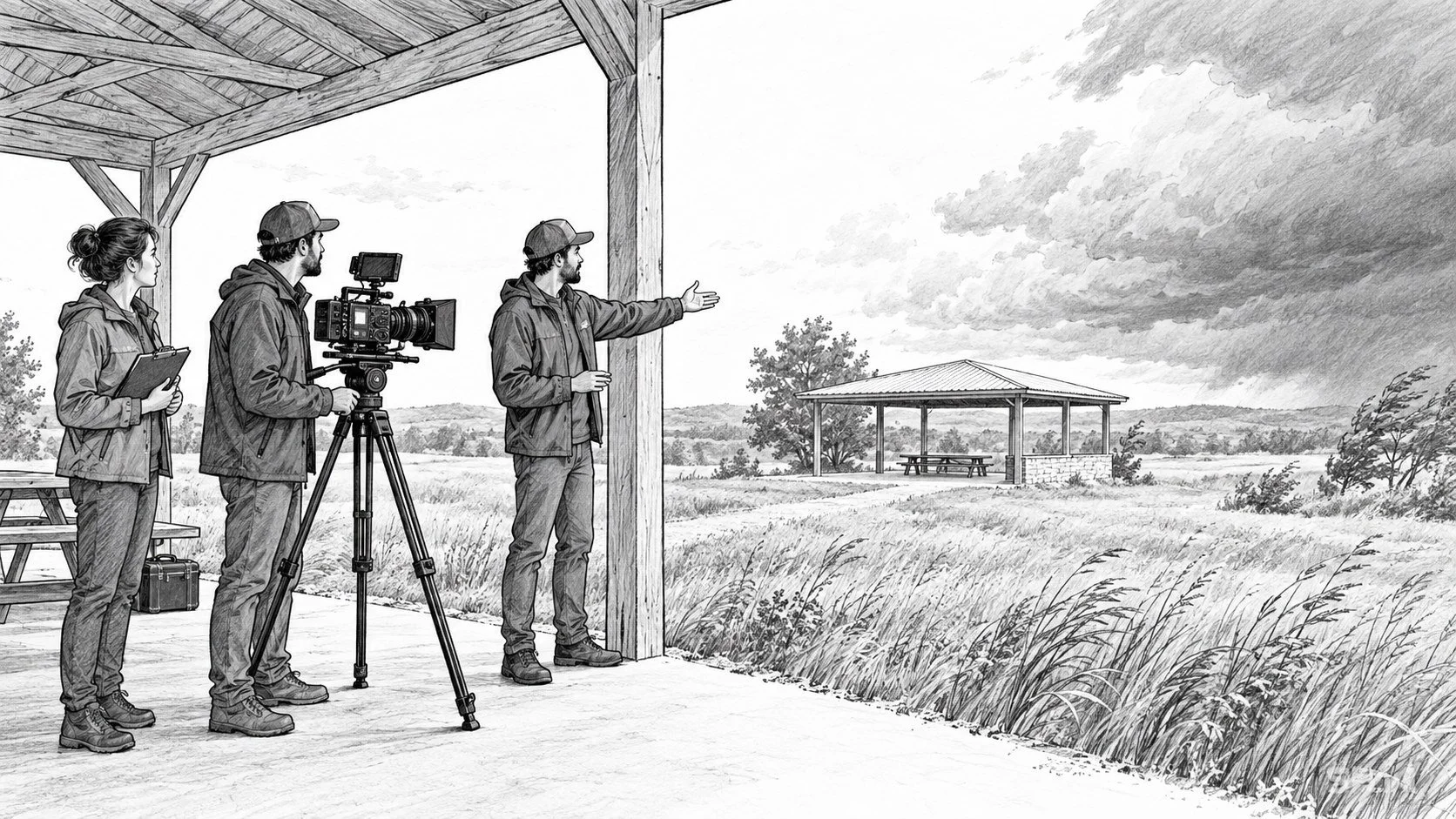
AI-generated storyboard illustration; a conceptual scene, not a client-production still.
Before hiring a Dallas commercial video production company for an outdoor project, ask for a weather plan that says more than “we’ll watch the forecast.” A plan answers three questions:
Who has authority to pause, move, or cancel the shoot?
What forecast or on-site condition triggers that decision?
What will the crew film instead if the original plan no longer works?
Ask who owns the weather decision
A weather plan should name one decision-maker and one backup. That person may be the producer, production manager, or another qualified lead—not a group chat in which everyone is waiting for someone else to speak up. The plan should define when conditions will be reviewed:
during initial location planning;
at the pre-production meeting;
the day before the shoot;
at crew call; and
during production when conditions change. The National Weather Service recommends that organized outdoor activities specify when to stop, where people go for safety, when activities may resume, and who monitors conditions and makes the call. Those principles apply well to a film set, even though a production has its own call sheet and chain of command. Read the National Weather Service lightning safety guidance, and make sure the production’s plan follows local safety requirements and the location’s rules.
Separate visual weather from hazardous weather
“Bad weather” is not one category. A gray sky may change the look while leaving the work feasible. Wind can affect sound, umbrellas, stands, dust, foliage, and safe movement. Rain can change access, continuity, equipment protection, and whether a location owner still permits filming. Heat can affect people, animals, batteries, makeup, wardrobe, and the pace of the day. Lightning is different: it is a safety condition, not simply a creative inconvenience. The NWS states that there is no safe place outside during a thunderstorm and advises stopping outdoor activity and moving to a substantial building or an enclosed hard-topped vehicle. A weather plan should identify the shelter before the crew arrives; a small shed or open rain shelter may not be adequate. The plan should also state who monitors official forecasts, radar, and other appropriate alerts, and who communicates a stop or resume decision. Do not turn a general internet rule into a universal production guarantee. Conditions vary by location, activity, terrain, and authority. The crew’s safety lead and local guidance take precedence over a client’s preferred shot list.
Build trigger-to-action pairs
A practical plan pairs each condition with an action. For example:
Lightning or thunder in the area: stop outdoor work, move people to the preselected safe shelter, account for everyone, and resume only when the designated safety plan allows it.
Rain that changes the location or equipment risk: protect equipment, pause the setup, move to a covered or indoor option, or shift to a different scene.
Wind that affects stands, sound, vehicles, dust, or talent: reassess the setup, reduce exposed equipment, change the blocking, or move the scene.
Cloud cover that changes continuity: decide whether to embrace the softer look, re-block for consistency, or switch to a scene less dependent on direct sun.
Heat or poor air conditions: adjust work rhythm, shelter, hydration, wardrobe, talent requirements, and the day’s order with the production lead.
A forecast that makes the planned scene unreliable: use the backup creative rather than improvising a risky substitute on location. These categories do not replace a site-specific safety assessment; they make decisions visible before the crew is under pressure.
Require a backup creative plan—not just a rain date
A rain date may not solve a location, talent, seasonal, or launch problem. Ask for a backup creative plan that preserves the message when the hero setup changes. A covered pavilion may help filming in nonhazardous conditions, but it is not lightning shelter. During thunderstorms, use a substantial building or enclosed hard-topped vehicle—not the covered structure shown in the storyboard—per NWS guidance. A backup may include:
detail shots and product actions that work under overcast light;
interviews or demonstrations moved to a covered location;
interior scenes that establish the same brand world;
macro textures, hands, tools, preparation, or travel beats;
a different sequence that does not depend on the original background; and
planned cutaways that protect the edit if the main activity is shortened. The backup should be written in story terms. “Get B-roll” is not a plan. “Show how the guide prepares the equipment, explains the decision, and gets the product ready for the next attempt” gives the crew something useful to capture while preserving the film’s purpose. Ask how the original and backup material will cut together. If the answer depends on matching a particular sun angle, wardrobe condition, or wetness level, the continuity risk should be documented before filming.
Put daylight and access on the feasibility checklist
Ask which scenes depend on daylight direction, shadow shape, background activity, or a location’s access window. Before approving feasibility, confirm shelter and vehicle access, the nearest alternate location, participant welfare, equipment protection, sound risks, permits, emergency contacts, and which scenes are essential or optional. A production partner should connect weather to story, schedule, safety, and deliverables—not simply list equipment. For broader preparation, compare this checklist with Fragrant’s corporate film planning guide, especially its sections on access, constraints, approvals, and distribution. You can also review the Fragrant Film work page to see the range of environments a production approach may need to support.
A weather-plan worksheet for your next call
Ask each finalist to answer these questions in plain language:
Who makes the safety and feasibility call, and who is the backup?
What conditions trigger a pause, move, cancellation, or creative switch?
Where will the crew go if outdoor work stops?
Who monitors conditions, and how will the decision reach every department?
Which scenes are essential, flexible, or optional?
What backup creative keeps the central message intact?
What access, sound, equipment, talent, animal, or location constraints change with weather?
What must be decided before travel, and who approves a revised plan on the day? A production company does not need to promise perfect conditions. It should make uncertainty manageable. A strong weather plan gives your team authority, a safe response, and a story-preserving alternative. That is a better basis for approving an outdoor shoot than a promise that the forecast will cooperate.