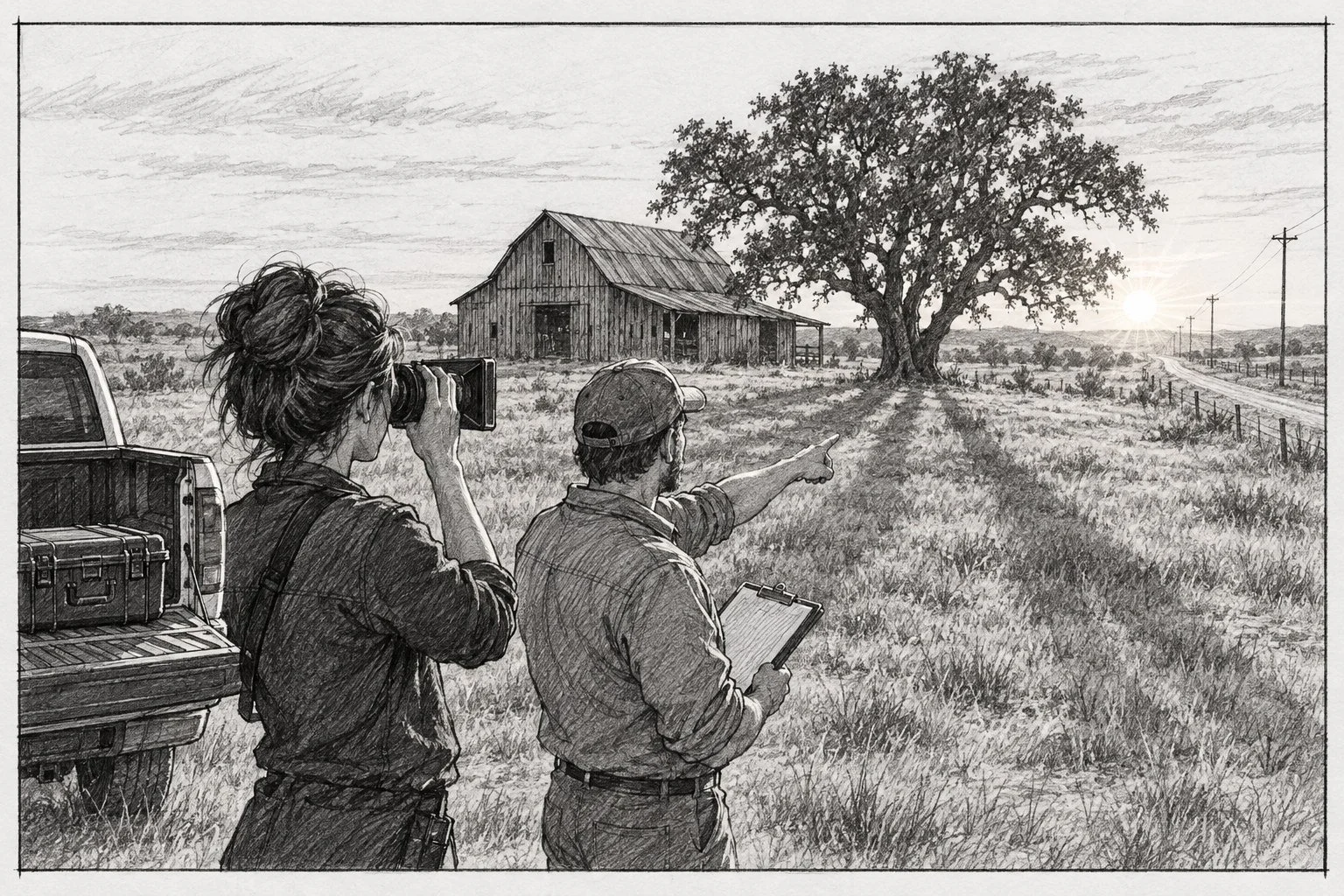
AI-generated storyboard illustration; a conceptual scene, not a client-production still.
Shoot on location when the place itself is part of the proof: the real ranch, the working plant, the product used where your customer actually uses it. Shoot in a studio when the product, the message, or repeatability matters more than the setting, or when you need light and sound you can control to the minute. Plenty of commercial shoots end up doing both. The more useful way to decide is to understand what each choice really buys you. A studio moves cost and decisions into prep. A location moves risk into the shoot day. Below is how to weigh that tradeoff, where the costs hide on each side, what permits look like in Dallas–Fort Worth, and a scout checklist you can bring to the walk-through.
Start with what the setting has to prove
Before comparing day rates, answer one question: does the audience need to believe this happened somewhere real?
For an outdoor equipment brand, the answer is usually yes. Mud on the tires, wind in the grass, and a horizon that keeps going are part of the argument. Rebuilding that on a stage is possible, but it is expensive and rarely convincing at commercial budgets. For a product demo, a talking-head explainer, a tabletop food spot, or a series of short social videos that need to match each other over months, the setting is mostly a container. There, control and consistency usually beat authenticity.
Most briefs fall somewhere between. A useful test is to list each scene and mark whether the location is evidence (it proves something about the brand) or backdrop (it just needs to look good and stay out of the way). Evidence scenes lean toward location. Backdrop scenes are candidates for a studio, or for a location that behaves like one, such as a quiet interior you can lock down for the day.
What each option actually controls
The real difference between location and studio is which variables you can control and which you have to plan around.
Light. On location, the sun sets your schedule. Usable warm, low light at the start and end of the day is short, and every setup you want in it competes for the same window. In a studio, the light stays wherever you put it, for as long as you need it.
Sound. Exteriors bring traffic, wind, aircraft, livestock, and HVAC units you didn't notice on the scout. A studio built for production is quiet by design, which matters most when people are speaking on camera.
Schedule. A studio day is predictable: load in, prelight, shoot, strike. A location day has company moves, travel between setups, weather holds, and an owner's rules about when you can arrive and leave.
Authenticity. Real places carry texture and scale that are hard to fake: dust in backlight, real distance, wear on surfaces. A studio can only show what you build or bring in.
Repeatability. If you will shoot more videos later and need them to match, a studio, or a documented interior setup, is far easier to recreate than a field at a particular time of year.
Where the costs hide on each side
Neither option is automatically cheaper. They spend money in different places, and estimates often make one look cheaper simply because some costs haven't been counted yet.
Location costs that show up late
Company moves. Every time the crew relocates, you lose shooting time to packing, driving, and resetting. Two locations an hour apart can cost a meaningful part of the day.
Permits, insurance, and city services. Public property, street use, and blocked sidewalks can bring permit fees, required insurance certificates, and sometimes off-duty police for traffic control (more on DFW below).
Power and basecamp. Remote sites may need a generator, which brings its own noise and placement problems, plus restrooms, shade, parking, and a holding area for talent and clients.
Weather contingency. A backup day, a cover set, or a weather-call deadline belongs in the plan from the start. Our guide to planning for weather on outdoor shoots covers how to build one, including Texas heat.
Restoring the property. Some agreements require returning the site exactly as you found it, and that takes crew time at the end of the day.
Studio costs that show up late
Prelight and strike time. Stages usually bill for the hours you are setting up and tearing down, not just the hours you are rolling. A complicated lighting setup may need its own prelight day.
Building the world. An empty stage shows nothing. Sets, props, flats, and art direction cost money, and a set that has to look like somewhere specific costs more.
Lighting everything. Outside, the sun lights the whole frame for free. Inside, every square foot the camera sees has to be lit by a fixture someone rigged, and wide shots get expensive.
Faking outdoors. Recreating daylight, sky, and distance indoors is a specialty skill. Done cheaply, it looks like a stage, and audiences notice.
The practical takeaway: a studio moves cost and decisions into prep; a location moves risk into the shoot day. Neither is wrong. What matters is which risk your project, schedule, and approval chain can absorb.
What a high-end set teaches about bringing the outdoors inside
The clearest example of this tradeoff at the top of the industry is The Mandalorian. In American Cinematographer's account of the first season, the production faced exactly this problem: Star Wars audiences expect sweeping, exotic exteriors, but taking a crew to remote deserts on a television schedule and budget wasn't realistic. The team, including cinematographers Greig Fraser and Barry "Baz" Idoine, shot many of those environments inside a stage on a curved LED wall known as "the Volume." The screens displayed real-time 3D backgrounds that also cast interactive light and reflections on the actors and Mando's reflective armor, something green screen handles poorly.
The lesson for a brand shoot isn't "rent an LED volume." It's what the approach required. The environments had to be built, approved, and tuned before the cameras rolled, rather than discovered on location or finished in post. That is the studio tradeoff at any budget. Moving the outdoors inside doesn't remove decisions; it moves them earlier. If your approval process tends to settle things late, a studio-built exterior will be painful. If your team can lock the look in pre-production, it can buy real control.
Permits and paperwork in Dallas–Fort Worth
Permits are one of the biggest practical differences between location and studio shoots, and the rules vary by property. This is general guidance, not legal advice; your production company should confirm requirements for each location.
Private property in Texas. According to the Texas Film Commission's permitting overview, a location entirely on private property does not need a film permit, but it does need permission from the owner in a valid location agreement. If vehicles, crew, or equipment block public access, such as sidewalks or roads, you need both the agreement and a municipal permit. There is no statewide blanket permit.
City of Dallas. The Dallas Film Commission's permit guide says permits are needed for filming on city property, using streets or alleys, blocking sidewalks, or parking in restricted curb lanes, among other cases. The city asks for at least three business days of review, or five for complex productions, and requires a certificate of insurance before it will issue the permit.
Fort Worth. Fort Worth's film office notes that requirements vary from location to location. Districts like the Stockyards and West 7th have their own applications and insurance requirements.
Drones. Aerial shots bring their own FAA requirements, and much of DFW sits near busy airports. Our list of questions to ask before hiring a video production company covers what paperwork to request.
A studio avoids most of this, because the stage is private property with its own rules. That's a real advantage when your timeline is short and your shoot date can't move.
A quick decision guide
Location usually wins when:
The setting is evidence: the real farm, store, plant, or landscape your customer recognizes.
You need scale or distance a stage can't provide.
The look depends on natural light you can schedule around.
The product is meant to be used outdoors and should look dirty, wet, or worked.
Studio usually wins when:
People speak on camera and clean sound is non-negotiable.
The product is the hero: tabletop, packaging, detail work, demos.
You need many setups in one day without chasing the sun.
Videos must match across a series shot over months.
The shoot date is fixed and a weather delay isn't an option.
Hybrid usually wins when: the story needs a few authentic exteriors, but interviews, product shots, or graphics-heavy material can be captured under control. Many commercial projects shoot the hero exteriors on location and the product and interview work in a studio or controlled interior.
One more consideration: if the project needs vertical and square versions, a location has to hold up in more framings. Vertical frames show more sky and ground, so more of the place has to look right. Our guide to planning cutdowns and vertical versions before the shoot explains why.
A location scout checklist for marketing teams
If you join a scout, these are the questions worth asking while you are standing there, ideally at the same time of day you plan to shoot.
Where is the sun at call time and at wrap? Which direction do the key shots face, and when does the background fall into shade?
What do you hear when everyone stops talking? Listen for a full minute: traffic, flight paths, trains, generators, HVAC, animals.
Where does power come from? House power, a generator, or batteries, and where the generator can sit without being heard.
How do trucks and gear get in? Gate widths, ground conditions after rain, stairs, elevators, and the walk from parking to set.
Where do people wait? Shade or air conditioning, restrooms, a spot for wardrobe and makeup, and a place for clients to watch without being in the shot.
What's in the background? Signage, logos, neighbors' property, artwork, and anything else that might need clearing or hiding.
What does the owner allow? Hours, off-limits rooms or areas, furniture moves, vehicle placement, and who on site can say yes.
Is there a backup here? An interior, a covered area, or a second angle on the same property you can move to if weather turns.
Can we reach anyone? Cell signal and data for remote viewing or file transfer, plus the nearest hospital and safety access.
Questions to ask your production company
Which scenes do you recommend shooting on location, which in a studio, and why?
How does each option change the schedule, the crew, and the risk to the shoot date?
What's included in the estimate for permits, insurance, power, basecamp, and weather contingency?
If we shoot in a studio, what has to be designed and approved before the shoot, and by when?
If weather turns on location, what's the plan and who makes the call?
A strong answer explains the tradeoff for your scenes rather than defaulting to how the company usually works. For a look at how different settings come through on screen, see our recent work.
The bottom line
Location or studio isn't a style preference. It's a decision about which variables you need to control and which ones you're willing to plan around. Start by deciding which scenes need a real place as evidence, then count the hidden costs on both sides and match the choice to how your team makes decisions. Teams that can lock a look early get a lot out of a studio. Teams whose story depends on a real place should budget the time, permits, and contingency that location work asks for, and then let the place do what a stage can't.