Shoot Once, Cut Many: Plan Your Video Cutdowns and Vertical Versions Before the Shoot
If a commercial video has to run as a 60-second hero film, a 15-second paid social ad, a vertical Reel, and a LinkedIn post, write that down before the shot list exists. Every placement changes something on set: framing, coverage, the opening seconds, audio, and sometimes talent and music rights. When those versions only show up during the edit, the editor has to work around footage that was never shot for them. The cheapest moment to plan a cutdown is before the camera rolls. Here is how to build a simple deliverables matrix, and what each line of it means for the production.
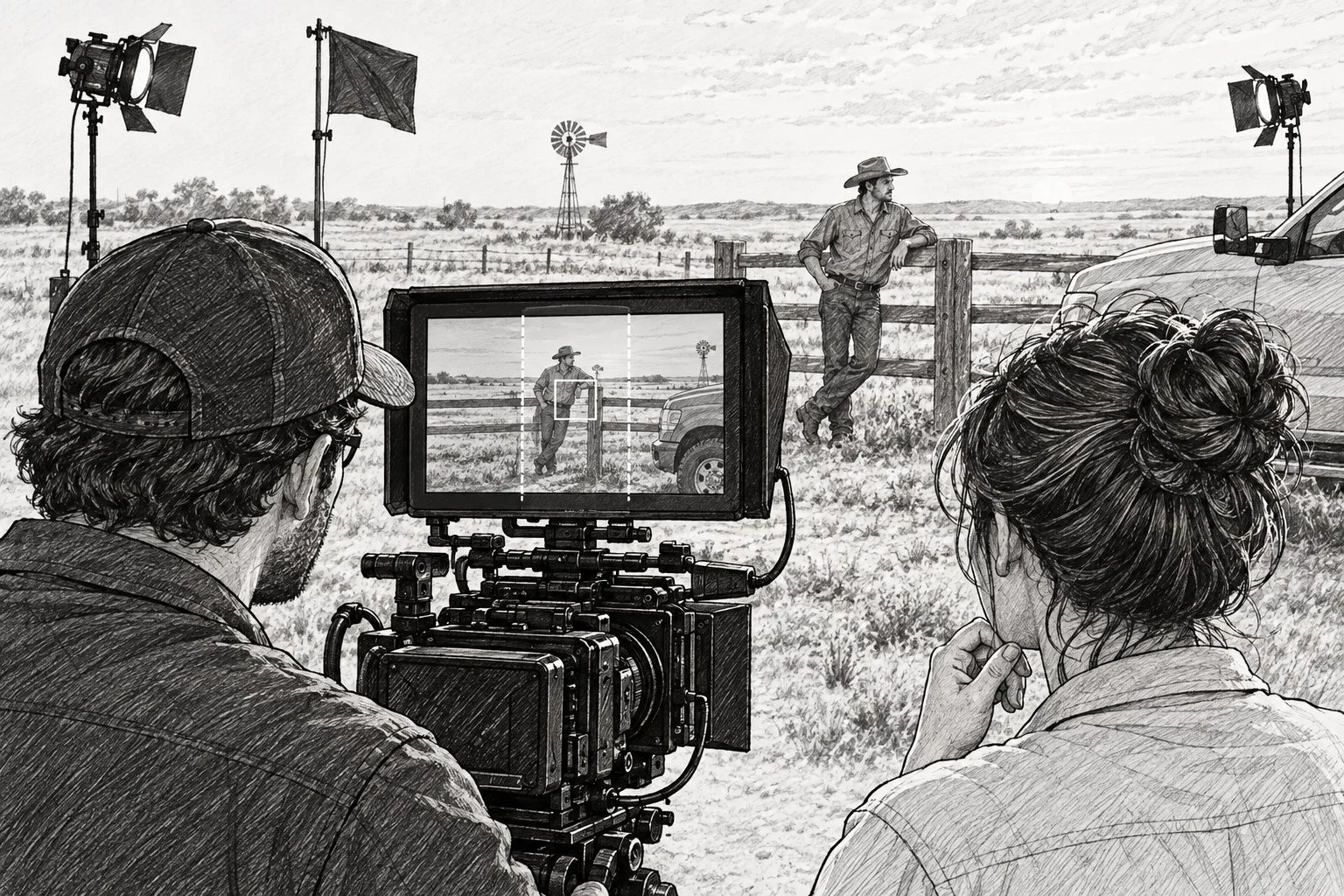
AI-generated storyboard illustration; a conceptual scene, not a client-production still.
Why cutdowns break when they are planned in the edit
A cutdown is not a shorter copy of the master. A 15-second version needs its own opening, its own payoff, and a reason to exist without the 45 seconds around it. A vertical version is not a cropped horizontal one either. It has a different frame, and on social platforms part of that frame is covered by on-screen interface elements. When versions are an afterthought, three things tend to go wrong:
No standalone moments. The story only works in sequence, so short edits feel like trailers for a video nobody will see.
Framing that cannot be rescued. A beautiful wide two-shot puts people at the far edges of the frame. A centered vertical crop of that shot keeps the space between them and loses both faces.
Missing materials. Nobody recorded alternate lines, clean background plates, or stills, so the "extra" assets end up as screen grabs and recycled shots. None of this is solved by a bigger budget. It is solved by deciding what the footage has to become before deciding how to shoot it.
Build the deliverables matrix first
Start with distribution, not with the creative. List every place the video is expected to run in the next six to twelve months, then fill in one row per placement. A spreadsheet is fine. The point is to give the director, producer, and editor the same list. Deliverables matrix: one row per placement
Placement: Where will it run? Website hero, YouTube, paid Meta (Reels/Stories/Feed), organic Instagram, LinkedIn, trade-show loop, sales deck.
Length: Target runtime. Be specific: "15s" and "up to 30s" lead to different edits.
Aspect ratio: 16:9, 9:16, 4:5, or 1:1. Note which one is primary for that placement.
Sound assumption: Will most people hear it, or does it need to read with sound off (on-screen text, captions, visual storytelling)?
Paid or organic: This matters for usage rights, ad review, and how hard the opening has to work.
Owner: Who on your team approves this version?
Production impact: What this row requires on set. The rest of this article is about filling in this column. Check current specs at the source, because platforms change them. As of this writing, YouTube says square or vertical uploads up to three minutes are categorized as Shorts. LinkedIn's video ad specifications accept aspect ratios from 9:16 to 16:9. Meta's safe-zone guidance says to keep the top, bottom, and side edges of 9:16 ads free of key text and logos, and to leave the bottom 40% clear on Reels ads that carry disclaimers. Treat those details as inputs to the matrix, not permanent rules.
What each line changes on set
Vertical versions: crop or shoot dedicated setups
There are two honest ways to get a 9:16 version, and most good productions use both. Extract it from a horizontal frame. Shooting at a high enough resolution lets the editor pull a vertical frame from a horizontal shot. The math is simple: a full-height 9:16 slice of a 3840×2160 (UHD) frame is about 1215×2160 pixels, which comfortably exceeds a 1080×1920 vertical delivery. The same slice of a 1920×1080 frame is only about 608×1080 and would have to be scaled up. Ask your production company what acquisition resolution it plans to use, and whether the camera offers a taller sensor mode for more reframing room. Resolution solves sharpness, not composition. The camera operator has to protect the vertical frame by keeping the subject, product, and key action inside a center-safe area marked on the monitor. That is what the dashed lines in the storyboard above represent. Protecting for vertical slightly changes how horizontal shots are composed, so the director and cinematographer should agree on which shots get that treatment. Shoot dedicated vertical coverage. For the moments that will open the vertical edit, such as the hook, the product reveal, or a key line from talent, a dedicated vertical setup usually looks better than an extraction. The camera can be re-rigged, the frame composed for height, and camera movement designed for a tall frame. A lateral slider move that looks elegant in 16:9 often becomes a jittery reframe in a 9:16 crop. The tradeoff is time. Each dedicated setup means re-rigging, re-lighting for a taller frame, and clearing more of the location. A practical rule: extract for coverage, shoot dedicated vertical for the hero moments. Put the dedicated shots on the shot list by name so they are not the first thing cut when the day runs long.
Short cutdowns: plan the opening, not just the runtime
For each short version, ask: what does the viewer see in the first few seconds, and does it make sense without anything before it? That usually means capturing specific "hook" coverage:
A clear product or brand moment that can open a cut, not only close it.
Short, self-contained actions, like a gate opening, a tool in use, or a reaction, that carry meaning in two or three seconds.
Alternate line reads: the full line for the hero film, plus a shorter version (a "lift") for the 15-second and 6-second edits. If the script depends on a slow build, have the producer flag which beats can stand alone. That one conversation does more for a short cutdown than any amount of fast editing.
Sound-off viewing: make the story readable
If the matrix says a version will often be watched muted, the creative has to work visually. On set, that means clean dialogue and voiceover for accurate captions, a little room in the frame for on-screen text (inside the safe zones), and a few shots that clearly show what is happening without narration. Scripts built entirely on spoken dialogue are harder to adapt. A director who knows this can stage key information visually rather than relying only on the line.
Stills and thumbnails: assign them, don't grab them
If you need photography for the website, paid ads, or thumbnails, decide whether a dedicated photographer, behind-the-scenes coverage, or frame grabs will cover it. Frame grabs from motion-blurred footage rarely make strong stills. A short, scheduled stills window during the best light is usually a better use of 20 minutes than an extra take.
The outdoor complication: a vertical frame sees more of the location
On outdoor shoots, a vertical frame shows more sky above the subject and more ground below. That changes the work on location:
More sky means more exposure decisions. A bright midday sky that sits at the edge of a horizontal frame can take up the top third of a vertical one.
More ground means more to hide. Cables, sandbags, light stands, and footprints near the subject's feet often enter a tall frame. Crew have to clear a deeper area for each setup.
Wind and flags show up. Diffusion frames and flags placed just outside a horizontal frame may sit inside the vertical one. None of this is a reason to avoid vertical. It is a reason to tell the production company early, because it affects the schedule, the gear list, and how much time each setup really takes.
Put the deliverables in the agreement
Once the matrix is agreed, carry it into the estimate and the agreement. Name the versions, not just "social cutdowns." A useful deliverables list usually covers:
Masters and versions: each runtime and aspect ratio, by name.
Text and graphics: versions with on-screen text and textless versions for future localization or re-editing.
Captions: a burned-in captioned version, separate caption files, or both.
Audio: final mix plus separate dialogue, music, and effects stems if you expect future edits.
Stills and thumbnails: quantity, how they will be captured, and delivery format.
Rights: where, for how long, and in what media talent, music, and footage can be used. A version that runs as a paid ad may need different terms than an organic post. Confirm rather than assume.
Revision rounds and versioning: how many rounds apply to the master, and whether cutdowns get their own.
Footage and project files: whether raw footage and edit files are delivered or archived, and for how long. For more on comparing these lines across bids, see how to compare outdoor video production estimates, which covers deliverables, rights, and revisions side by side.
Budget tradeoffs: where versions cost money, and where they save it
Versions are not free, but planning them is usually cheaper than fixing them. Each additional aspect ratio and runtime adds editing, graphics, and finishing time. Dedicated vertical setups add time on the shoot day. Broader usage terms can raise talent and music fees. If the budget is tight, rank the matrix rows by business value rather than trimming every version a little:
Keep the placement that will carry the most paid spend fully supported, with dedicated coverage and a proper hook.
Let lower-priority placements use extracted frames and repurposed moments.
Postpone versions you might need later, but capture the materials now (lifts, protected framing, textless masters) so they stay possible.
A hypothetical example
This example is illustrative, not a Fragrant Film project. A regional equipment dealer plans a 60-second brand film for its website, a 15-second paid Reel for a spring promotion, and a 30-second LinkedIn cut for dealer recruiting. Without a matrix, the crew shoots beautiful wide landscapes and long dialogue takes, and the Reel ends up as a center crop that loses the product. With a matrix, the producer schedules two dedicated vertical setups for the product reveal, records a shorter line read for the 15-second edit, protects the center frame on the key wides, and books a short stills window at golden hour. The shoot day gets slightly longer, but the edit gets much simpler, and every version has footage made for it.
The short version
Decide where the video will run before you decide how to shoot it. Build one row per placement, ask your production company what each row changes on set, and write the versions into the agreement. If you are weighing who should own that planning, this comparison of production companies, agencies, and videographers explains how responsibility can be split. You can also see how finished campaigns come together on the Fragrant Film work page.