Questions to Ask Before Hiring a Video Production Company (and What Good Answers Sound Like)
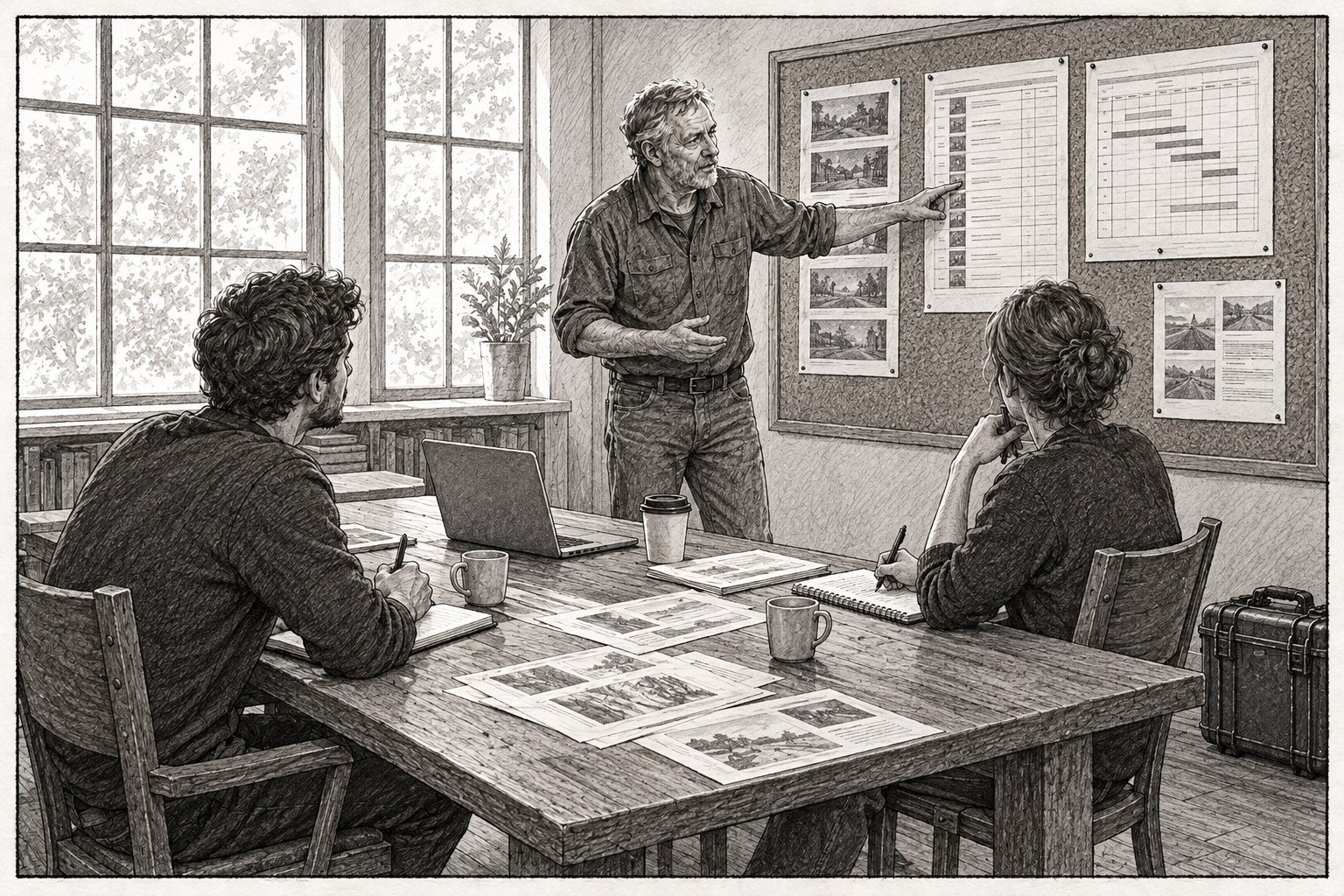
AI-generated storyboard illustration; a conceptual scene, not a client-production still.
The most useful questions to ask a video production company aren't about cameras or style. They're the ones that make a team get specific: who will actually do the work, how decisions get made, what happens when something goes wrong, and what you'll own when it's over. A strong company answers with names, documents, and examples, and explains the tradeoffs without being asked. A weaker one stays general and leans on its reel. Below are the questions worth asking, what a good answer sounds like, the red flags behind each one, and a simple scorecard for comparing finalists side by side.
Before the call: set it up so the answers are comparable
Interviews go better when every company is answering the same question about the same project. A few habits make that possible:
Send a short brief first. Objective, audience, where the video will run, timing, and a budget range. Without a range, every company guesses, and you end up comparing guesses instead of approaches.
Ask for the people who would run your project. A business-development lead can describe the company. Only the producer or director who would actually be assigned can describe how your project would go.
Bring whoever signs off. If a VP will approve the final cut, they should hear how each team handles feedback before the contract is signed, not after.
Use the same questions and take notes against the scorecard at the end of this guide. Memory favors whoever was most charming.
If you haven't decided whether you need a production company, an agency, or a single videographer, settle that first. Our guide on who should lead your commercial video walks through that decision. The questions below assume a production company is the right fit.
Questions about the work they've shown you
"Which projects on your reel did you produce from start to finish, and what was your role on the others?"
Reels mix different kinds of work: full productions the company led, days where its crew was hired by another company or agency, and personal or spec pieces. All of that is legitimate, but it's different evidence. A company that shot beautiful footage on someone else's production has shown it can shoot, not that it can run your project.
A good answer sorts the reel without hesitation: "We concepted and produced these three. On this one, we were the camera and lighting team for an agency. This one was a personal project." A red flag is vagueness about roles, or a reel full of famous brands with no clear explanation of what the company actually did.
"Walk me through the project most like ours. What went wrong, and what did you do?"
Every real production has a problem story: a location that fell through, talent who froze on camera, weather that moved the schedule, a stakeholder who changed direction mid-edit. You're not testing whether problems happened. You're testing whether the team noticed early, made a call, and protected the client.
A good answer is specific and a little uncomfortable: what happened, the decision, the cost, and what they changed afterward. A red flag is "nothing really goes wrong for us." Either the team is inexperienced or it isn't being straight with you.
"Can I talk to a client from a project like this?"
Ask for a reference from a similar project, not the company's happiest client. When you call, skip "were you happy?" and ask: How did they handle feedback? Did the final cost match the estimate, and if not, why? Would you hire them again for something harder?
Questions about who will actually do the work
"Who will direct, who will produce, and who is my day-to-day contact?"
Most production companies, including established ones, build each crew from a mix of staff and trusted freelancers. That's normal for the industry and isn't a weakness. The question is which key roles are committed to your project, and when.
A good answer names the director, producer, and editor, or explains when they'll be confirmed. It also explains how the company handles a key crew member who becomes unavailable. A red flag is a pitch from a senior director who turns out to be "overseeing" while someone else directs your shoot. That arrangement can work, but you should know about it before you sign, not on set.
"Who edits, and will the director stay involved in the edit?"
In many projects the edit is where the film is made, especially anything documentary or interview-based. A company where the director hands off the footage and walks away can produce a very different film from one where the director shapes the cut. Neither is automatically wrong, but you should know which you're buying.
Questions about process and approvals
"What do you need from us before you write a treatment, and what will we approve at each stage?"
A good answer describes clear stages: brief, treatment or creative approach, pre-production (schedule, locations, casting, shot list), shoot, rough cut, fine cut, and delivery. You approve something specific at each one. A red flag is "we'll just start filming and figure it out." Some projects benefit from flexibility on the day, but a production with no approval structure tends to drift into costly reshoots or recuts.
"How many rounds of revisions are included, and what counts as a revision?"
This question prevents more disputes than any other. A revision is a change within the approved direction: tighten this section, swap a shot, adjust the music. A new direction, such as a different story, a new message, or new footage, is usually a change order. Ask the company to define both in writing, along with when rounds happen (rough cut vs. fine cut) and what an extra round costs.
"How will you handle feedback from several stakeholders?"
A good answer asks you to consolidate notes into one document from one decision-maker per round. That's not the company being difficult. Conflicting notes from three departments are one of the most common reasons edits run long. A strong producer will also tell you which stage is the cheapest time to make big changes, usually the treatment and rough cut, not the final color and sound mix.
Questions about scope, schedule, and money
We've covered how to line up competing bids in our guide to comparing video production estimates. On the interview call, focus on the assumptions behind the numbers:
"What does this estimate assume?" Number of shoot days, length of the day, locations, crew size, talent, music, and the deliverables list. If an assumption changes, the price should change in a way you can predict.
"What would cause an overage, and how will we know before it happens?" A good producer flags budget risk before spending the money, not on the final invoice. Ask whether overtime, extra travel, or added locations require your written approval first.
"What's the payment schedule?" Deposits at booking and balances at delivery are common. What matters is that the payments line up with milestones you can see.
"What happens if weather or a location falls through?" For outdoor shoots in North Texas, heat, storms, and wind are planning issues, not surprises. Our article on asking for a weather plan covers what a real answer includes, including who has the authority to call a weather day.
Questions about risk, rights, and the paperwork nobody enjoys
These questions rarely come up in a creative pitch, and they're where the real cost of hiring the wrong team tends to show up.
"Can you provide a certificate of insurance?"
Many locations, venues, and corporate facilities require proof of general liability insurance before a crew can set foot on the property. Some will ask to be named as an additional insured. A good answer is "yes, tell us who it needs to name," and a certificate arrives within a day or two. Hesitation here usually means the company doesn't carry the right coverage, and you may not learn that until the day before the shoot.
"Who flies the drone, and are they certified?"
In the U.S., flying a drone for commercial work generally falls under the FAA's Part 107 rules. The pilot needs a Remote Pilot Certificate, and the drone must be registered. Flying in controlled airspace also requires FAA airspace authorization. That matters around Dallas–Fort Worth, where DFW International, Love Field, Alliance, Meacham, Addison, and other airports put much of the metro inside controlled airspace. A good answer names the certified pilot, confirms that airspace has been checked for your location, and explains the backup plan if authorization isn't granted.
"What will we own when the project is finished?"
Don't assume that paying for a video means you own everything in it. Under U.S. copyright law, a commissioned work generally belongs to the company that commissioned it only when there's a signed written agreement. The U.S. Copyright Office explains this in Circular 30, Works Made for Hire. Otherwise, ownership is transferred by a written assignment or limited by a license. Ownership of the final video also doesn't automatically extend to music, stock footage, talent performances, or raw footage, which each come with their own terms.
Ask the company to spell out in the contract: ownership or license of the final deliverables, music license scope (organic social vs. paid ads vs. broadcast), talent usage terms, and whether you receive raw footage and project files. This is general information, not legal advice. Have your own counsel review the contract.
"How do you protect footage between the shoot and the edit?"
Footage is the one thing on a production that can't be bought again. On professional sets, cards are copied to at least two separate drives, and the copies are verified before any card is erased and reused. One copy is usually kept in a different location from the other. A good answer describes that routine in plain language and names who's responsible for it on set. A red flag is "we just keep it on the laptop."
What isn't a red flag
Some things buyers worry about are normal parts of how professional production works:
Renting equipment. Most companies own their core kit and rent specialty gear for each job. Renting the right camera or lens for the project is often better than using whatever happens to be owned.
Freelance crew. Hiring a gaffer, sound mixer, or makeup artist per project is how the industry runs at nearly every level.
Not quoting a firm price on the first call. A company that prices your project before understanding it is guessing. A range on the first call and a detailed estimate after a brief is a sign of care, not evasion.
Pushing back on your idea. A team that questions whether a 60-second film can carry six messages is doing its job. The red flag is a team that agrees to everything.
A scorecard for comparing finalists
Score each company from 1 (weak) to 3 (strong) on each line right after the call, while it's fresh. Weight the lines that matter most for your project.
Relevant evidence: Clearly explained work similar to your project in scope and type, with their role on each piece stated.
Problem-solving: A specific, honest story about a production problem and how they handled it.
Named team: Director, producer, and editor identified, or a clear plan and date for confirming them.
Process clarity: Defined stages, approvals, revision rounds, and change-order rules.
Budget transparency: Assumptions stated, overage triggers explained, payments tied to milestones.
Risk readiness: Insurance, drone certification and airspace, weather plan, and footage backup all answered without hesitation.
Rights clarity: Ownership, music, talent usage, and raw footage spelled out.
Creative judgment: Thoughtful pushback and a point of view on your brief, not just agreement.
References: A client from a comparable project who would hire them again.
A company with a slightly less impressive reel but strong scores on lines 3 through 7 is often a safer hire than the reverse. Beautiful footage is necessary, but it isn't enough on its own. For more on how we approach process and scope, our FAQ answers common questions, and our work page shows the kinds of projects we produce.
The short version
Ask questions that make a production company get specific: who did what on the reel, who will run your project, how approvals and revisions work, what drives the budget, and what you'll own at the end. Strong teams answer with names, documents, and honest problem stories. Score every finalist on the same lines, and choose the company that is clearest about how the work will get done, not just how good the last project looked.