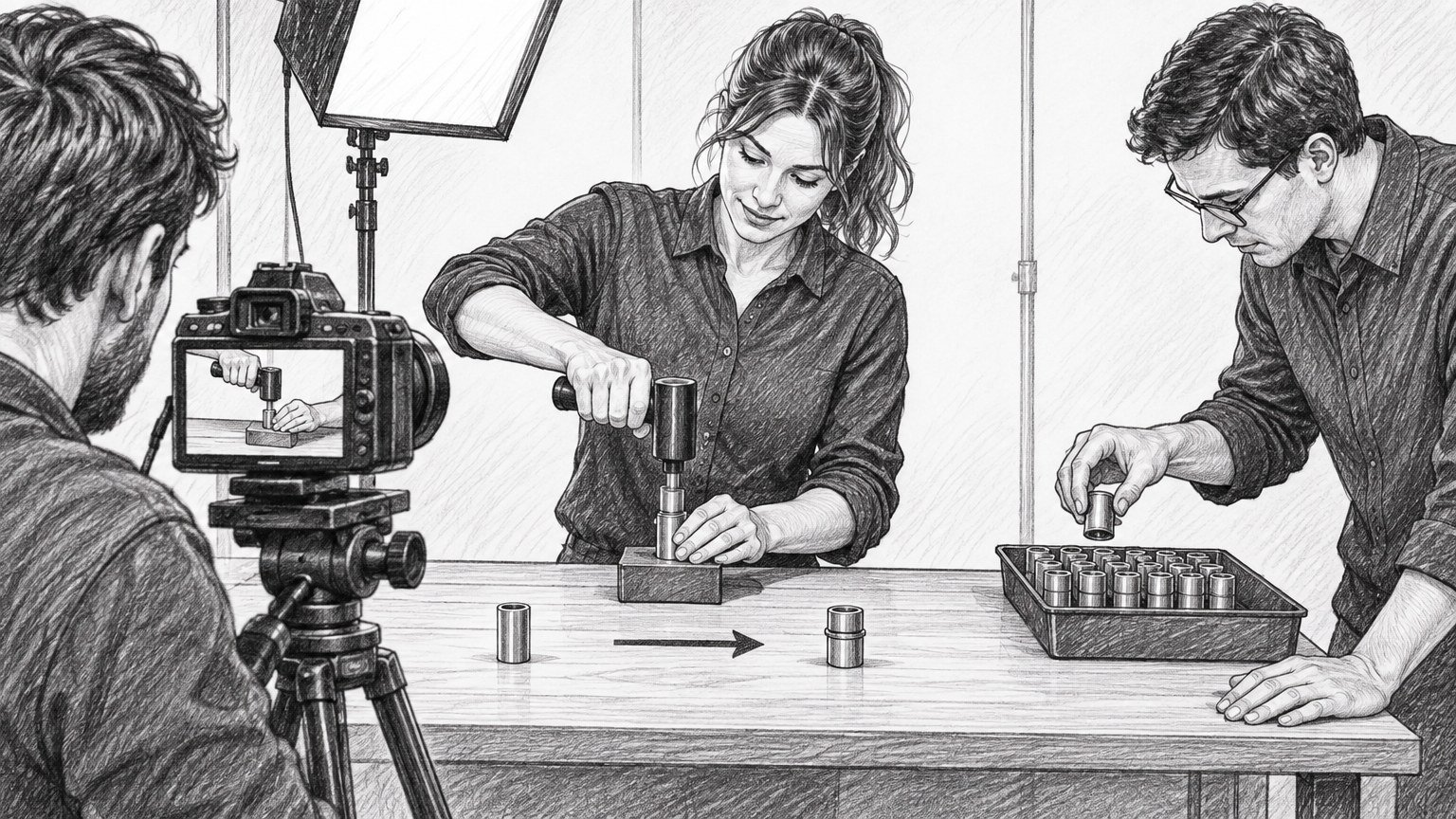
AI-generated storyboard illustration; a conceptual scene, not a client-production still.
A useful product demonstration answers a viewer's practical question: what happens when someone uses this, and why does that matter? Attractive detail shots can support that answer, but they cannot replace a clear sequence of action. Before hiring a production company to film a demo, define the one task the viewer should understand and the evidence the camera must capture.
Build the plan around a starting condition, an action, and an observable result. Then identify the views, resets, product units, and knowledgeable people needed to show that sequence reliably. This is a production framework for making use understandable—not a substitute for substantiating advertising claims, writing a complete instruction manual, or deciding whether your campaign needs a demo in the first place.
Choose one demonstration objective
“Show everything the product can do” is an inventory request, not a demonstration objective. Specify who is watching, what they already know, and the particular question the film should resolve. A buyer evaluating fit needs a different explanation from an experienced operator learning a new step.
The CDC's plain-language checklist recommends knowing the audience and purpose, putting the important message first, and organizing information into logical chunks. That source concerns communication materials, not a tested formula for product-demo films. Applied as a planning heuristic, it suggests a useful discipline: give the sequence one primary job and arrange supporting information around it.
Write the objective in observable terms. “The viewer can explain how the attachment connects” is easier to evaluate than “the product feels innovative.” Both may matter to the broader campaign, but they require different creative choices. Agree which one leads this particular piece.
Map the starting condition, action, and result
Walk through the actual process with a product expert before writing a shot list. What state must the product be in at the beginning? What does the user do? What changes in a way the viewer can observe? Which steps are essential to understanding and which are incidental preparation?
Record the real sequence before proposing an abbreviated screen sequence. This makes the editorial choice visible. A montage may omit repetitive waiting, but it should not accidentally suggest that a required setup step does not exist. If the demonstration is intentionally simplified, have the appropriate reviewers decide what context the viewer needs.
For a fictional tabletop assembly, the sequence might be an unconnected component, a visible connection action, and a completed configuration. The useful question is whether the camera can show the connection clearly. An elegant orbit around the finished object does not answer that question, however impressive it looks.
Assign every shot a comprehension job
Before adding visual flourishes, identify the minimum coverage that makes the action understandable:
Orientation: where the important parts are and how they relate.
Action: what the user's hands, the product, or the process actually do.
Critical detail: the point that would be ambiguous in a wider view.
Result: what visibly changed and how the viewer recognizes completion.
Continuity support: a view that connects steps without creating a misleading jump.
One shot can perform more than one job. The goal is not to multiply setups automatically. It is to prevent a shoot full of attractive fragments that cannot be assembled into a coherent explanation.
Ask the director to describe the viewer's attention in each shot. If the important action occurs behind a hand, label, reflection, or graphic, the shot needs reconsideration. Camera placement should serve the demonstration rather than make the operator work around a visually fashionable angle.
Test the action with the actual object
A product photo and a slide deck do not reveal all the filming constraints. Arrange a practical walkthrough with the real object or a representative unit. Check visibility, reflections, hand placement, movement, and the time needed to return to the starting condition.
For screen-based products, walk through the actual interface state and use appropriate test information. For physical products, identify any consumables, replacement parts, cleaning needs, or configuration changes. Have the responsible specialist explain what the team may and may not manipulate for filming.
Do not improvise unsafe operation to improve an angle or repeatability. Site procedures and qualified product guidance govern the action. If the safe and accurate sequence is difficult to photograph, solve the production design problem with the appropriate people rather than asking a demonstrator to work differently without authorization.
Scope resets as real production work
The first successful action is not necessarily the only take you need. A close view, a wider orientation shot, or a sound interruption may require repeating the sequence. Ask what must happen between takes and who owns that work.
A reset plan should identify the starting state, the person authorized to restore it, the materials consumed, and any limit on repetition. If an action permanently changes the object, determine whether additional units are needed. If the product must warm up, cool down, charge, or complete a process, put that dependency into the schedule without inventing a universal duration.
This planning is different from general crew efficiency. It determines whether the desired coverage is achievable at all. A production company cannot recover a clean “before” shot after the only sample has been irreversibly altered unless another solution was planned.
Choose the demonstrator for the action
The person who speaks most confidently about the product is not always the person who can perform the action clearly and repeatedly. Decide whether the sequence needs a technical expert, a trained operator, a presenter, or separate people for explanation and execution.
Ask the director how the demonstrator will be briefed. They need to understand camera framing and agreed pauses, while preserving accurate operation. Do not assume that a professional performer automatically has specialized product competence or that an expert operator automatically knows how to position a small object for a close shot.
The commercial casting framework can help with that broader choice. For this assignment, the acceptance question is narrower: can the selected person carry out the approved demonstration in a way the camera can communicate?
Keep explanation and evidence aligned
Narration, graphics, and the visible action should describe the same sequence. If the voiceover names a feature before the viewer can locate it, consider whether the picture needs orientation. If a graphic describes a result that the footage does not show, decide whether the film needs another shot or a more accurate explanation.
Separate a demonstration of operation from a claim about comparative performance. Filming a process clearly does not, by itself, establish every marketing conclusion someone might draw from it. Have the responsible client reviewers approve factual assertions and the conditions the presentation needs to preserve.
The same discipline applies to the edit. An omitted step may be harmless compression or a meaningful distortion; the product expert and creative team need to assess the actual sequence, not simply check that every approved sentence appears somewhere.
Use a shoot-ready demonstration record
For each distinct sequence, give the producer:
The intended viewer and one comprehension objective.
The approved starting condition and finished state.
The real action sequence, including essential setup.
The product/configuration reference and expert owner.
The views needed to understand the action.
Demonstrator, rehearsal needs, and operating boundaries.
Reset procedure, consumables, and repeatability limits.
Required spoken or graphic explanation.
Factual reviewer and acceptance method.
Connect this record to the production timeline and agreed scope. If a later request adds a second process or a substantially different configuration, use the change-order conversation rather than assuming it is merely another angle.
Test the finished explanation with someone representative
Before final approval, ask a person resembling the intended viewer to watch without coaching. Can they describe what happened, locate the important action, and explain the intended takeaway? Note where they hesitate or infer something the film did not intend.
This is a practical check, not proof of a universal comprehension or conversion lift. Use it to identify a missing view, an unclear transition, or an unnecessary layer of detail. A product expert's familiarity can hide gaps that are obvious to a new viewer.
A strong demonstration earns its beauty shots by first making the action legible. Define the task, plan the visible sequence, and prepare the object and people to repeat it accurately. The production team can then create a film that is both visually considered and genuinely useful to the person trying to understand the product.