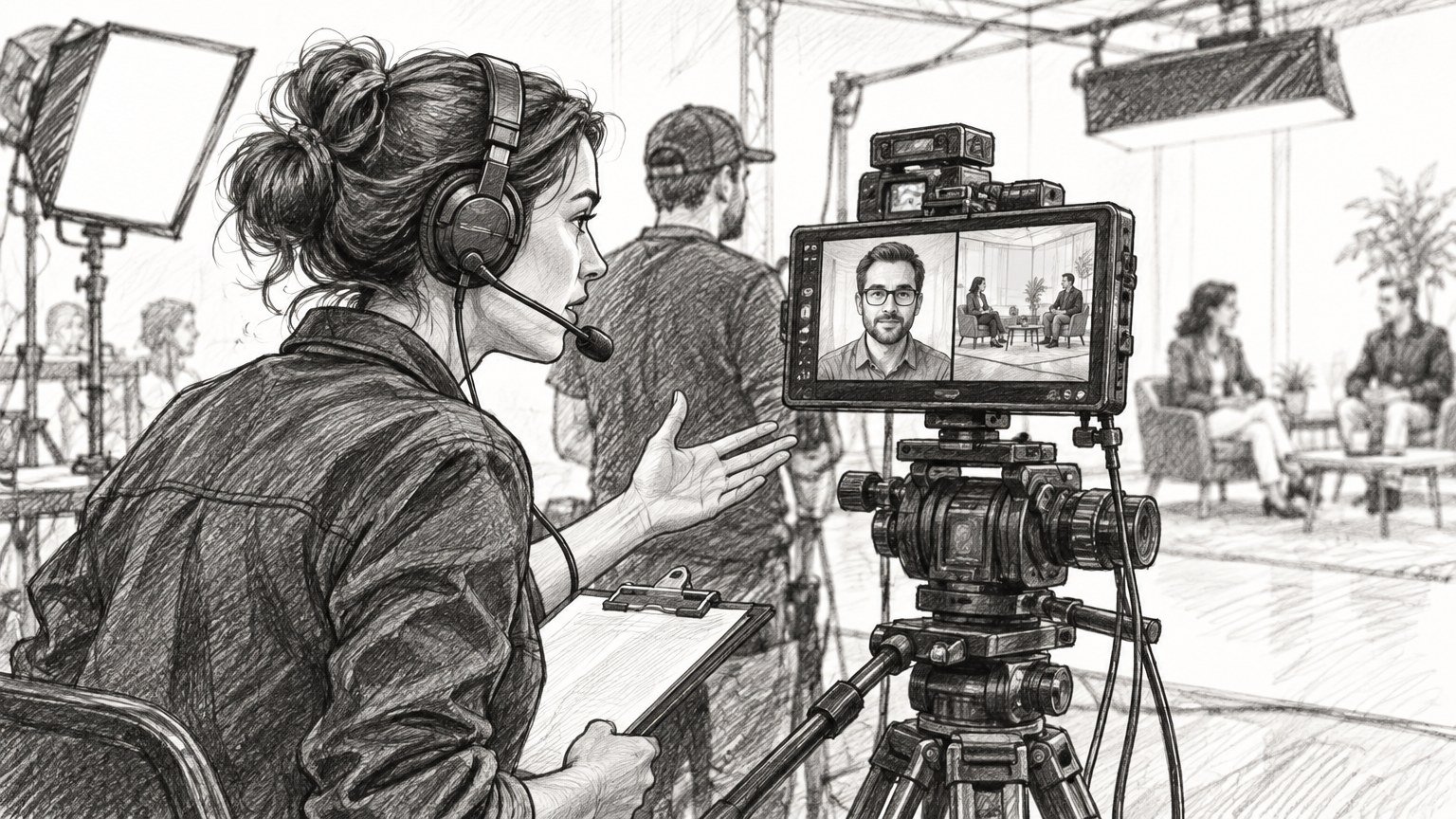
AI-generated storyboard illustration; a conceptual scene, not a client-production still.
Remote attendance is useful when the right client expert cannot be on set. It becomes expensive when everyone assumes that opening a video link creates a clear approval process. A remote viewer may see a different image from the camera original, receive clips after a delay, or join while the crew needs a time-sensitive decision. The meeting link does not resolve those differences.
Before the shoot, agree on what remote reviewers will see, which decisions they own, when they must respond, and what happens if the connection fails. Give one client representative authority to consolidate feedback. Treat remote attendance as a bounded production role, not an invitation for every stakeholder to direct every take.
This guide concerns client participation during a shoot. It is not a guide to remotely recording an interview subject, selecting a particular monitoring system, or reviewing a completed edit.
Name the decision that justifies attendance
Start by asking why the remote person needs to be present. A product specialist may need to confirm configuration. A brand owner may need to approve a specific visual treatment. A senior stakeholder may simply want visibility into progress. Those are different jobs, with different consequences if the person is unavailable.
Divide attendees into decision-makers, advisers, and observers. Only the first group should have authority to stop work within its agreed domain. Advisers provide input through the designated client lead. Observers need a viewing arrangement that does not imply a right to reopen every approved choice.
If someone cannot name the decision they will make, consider whether a scheduled still image or update would satisfy the need. Remote attendance should solve a production problem, not create a standing committee around the camera.
Specify what “watching remotely” means
A live view of the room, a camera image, an uploaded clip, and a still photograph provide different information. Ask the production company to describe the actual review output. Will the viewer hear usable production sound? See a reference image or a finished look? Watch continuously or receive selected takes?
Do not let a product name substitute for this explanation. Frame.io's Camera to Cloud connection guidance, for example, explains that pairing devices and uploading assets require internet access and that upload timing depends on factors including bandwidth, file characteristics, and the number of uploading devices. That documentation concerns a specific upload workflow; it is not a guarantee of a continuous live camera feed.
Ask what the proposed system can support at this location and what has actually been tested. Avoid promising a latency, resolution, compatibility, or uninterrupted service level unless it is supported by the chosen arrangement and the responsible provider.
Separate reference review from final image approval
Tell remote reviewers what they can reasonably judge from the feed. A compressed reference image may help confirm wardrobe, framing, or product placement. It may not be an appropriate basis for final judgments about fine detail, color, or sound quality.
Have the production lead explain the limitations in ordinary language before filming starts. If a viewer reports that an image looks dark or a sound is unclear, route the concern to the appropriate on-set specialist. Do not make the director change the lighting solely to compensate for an uncalibrated laptop screen without understanding the problem.
Where a critical decision requires more detail than the remote view provides, define a different check: a specific still, an uploaded take, or on-set confirmation by a named expert. Match the evidence to the decision instead of asking a weak reference to support a strong conclusion.
Build review windows into the shoot plan
Continuous access does not require continuous interruption. Identify useful checkpoints: before the first approved setup, before a hard-to-repeat action, or before releasing a specialist or location. Let the producer propose review windows that fit the sequence of work.
For each window, specify when the reviewer must be available, what they will receive, and how long the crew can wait for a response. Use project-specific timings rather than a universal rule. A quick wardrobe decision and a technical demonstration review do not need identical treatment.
Put those windows into the commercial production schedule. If a reviewer cannot attend, appoint an authorized delegate or resolve the decision in pre-production. Do not schedule an essential approval around an executive's unspecific promise to “try to jump on.”
Appoint one feedback channel
Choose a client lead who receives comments and communicates the decision to the producer. Keep informal observer chat separate from the channel that can stop or redirect work. Otherwise the crew may receive conflicting instructions from a text message, a conference call, and someone physically beside the camera.
Agree on a concise decision format: approved; approved with a specific adjustment; or not approved, with the issue stated. If the request is subjective, connect it to the approved creative direction. If it is factual, identify the expert whose judgment controls.
The client lead should resolve internal disagreements rather than asking the crew to arbitrate hierarchy. A director can explain the creative and production consequences of alternatives. The client must still identify which authorized preference or requirement prevails.
Define the no-response and connection-failure rules
Silence should not acquire a meaning by accident. Decide in advance what happens when a required reviewer does not respond. The answer may differ by decision: proceed within already approved boundaries, move to an independent setup, or hold a particular action until the expert is available.
Avoid a blanket “no response means approval” rule for decisions that genuinely require a specific check. Conversely, avoid stopping the entire crew for a nonessential observer. A useful fallback preserves the boundaries of the assignment while allowing independent work to continue.
Name the fallback communication method and the person who activates it. If the viewing route fails, can the team send a still or a selected clip? Who is permitted to approve from that alternative? If there is no adequate substitute, record the resulting hold rather than pretending the remote review occurred.
Keep participation secure and appropriately limited
Ask who can access the review session and any files it creates. Share invitations and assets according to the client's applicable information-handling requirements. Do not assume that every observer should receive downloadable camera originals simply because they joined a call.
If the shoot involves sensitive products, screens, or unreleased work, have the appropriate client owner approve the remote viewing arrangement. Limit the content shared to what the decision needs. The production team should know whom to contact if an unintended viewer appears or a recording setting is unclear.
These are coordination recommendations, not a claim that one platform or meeting configuration guarantees confidentiality. Confirm actual capabilities and requirements with the responsible teams rather than improvising security decisions on the shoot day.
Use an on-set remote-review record
A short record can prevent much longer disputes:
Reviewer's name, role, decision domain, and delegate.
Exact review output: room view, camera reference, still, or uploaded clip.
Known image, sound, timing, and connectivity limitations.
Availability window and expected response route.
Client lead authorized to consolidate feedback.
Decision required before a specific irreversible step.
No-response rule and connection fallback.
Access restrictions and any agreed recording policy.
Decision log identifying the setup or take reviewed.
The record need not document every casual comment. Capture decisions that affect what the crew does, especially when a client request changes an approved setup. Use the scope-change process for genuine additions rather than assuming remote comments are automatically included work.
End attendance when its job is done
Remote review during production does not replace rough-cut and fine-cut review. It approves specific on-set decisions within known viewing limits. The finished construction still needs its appropriate editorial and factual checks.
When the required decisions are complete, release the remote participants or move them to a noninterrupting observer arrangement. A clearly bounded role respects both stakeholder time and the crew's concentration.
The strongest remote-attendance plan is not the most elaborate technical setup. It is the one that connects a qualified person, adequate evidence, and a clear decision at the moment the production needs it. Establish those connections before the shoot, and remote participation becomes useful support rather than a second set operating by different rules.