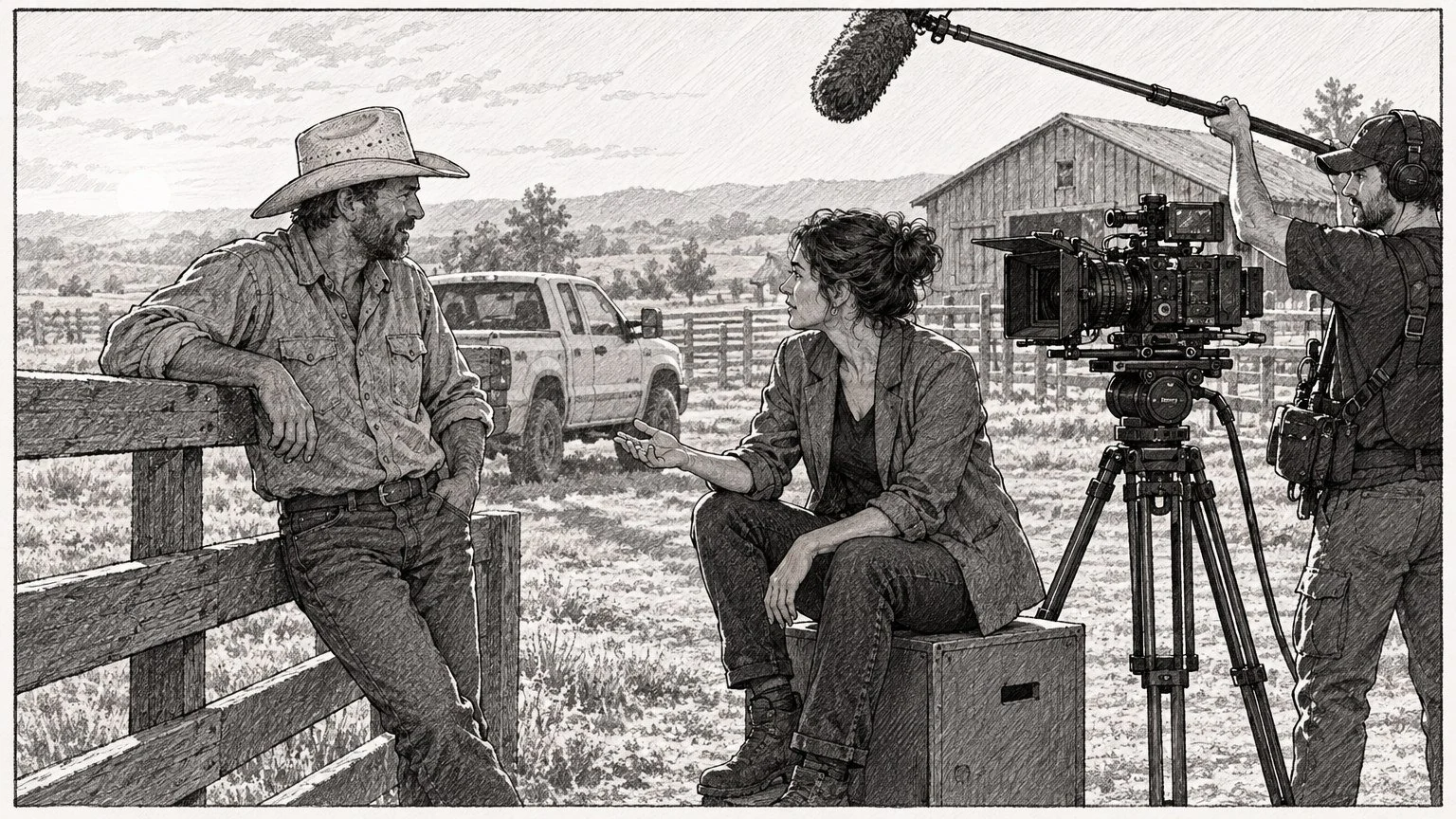
AI-generated storyboard illustration; a conceptual scene, not a client-production still.
Cast for what the viewer has to believe. If the message is "this works for people like you," real customers carry it best. If the message is "these are the people who stand behind it," your own employees are the most credible faces. If a scene needs scripted lines, a precise product demonstration, or the same moment delivered cleanly across many takes and versions, hire professional actors. Many strong commercials mix all three, with each group doing the part only it can do.
Casting looks like a creative choice, but it is just as much a decision about schedule, budget, legal paperwork, and how long the video can stay in use. This guide covers what each option really costs and controls, what the FTC expects when real people appear in ads, how directors get honest performances from people who have never been on camera, and a checklist to settle before anyone signs a release.
Start with what the viewer has to believe
Before talking about faces, write down the single claim the video has to make believable. Then ask who is the most credible person to make it.
"Customers like you get this result." That's proof from experience. Real customers are the most persuasive, as long as their experience is representative (more on that below).
"We know this work better than anyone." That's expertise and accountability. Employees, founders, technicians, and field staff are credible because the claim is about them.
"Imagine yourself here." That's aspiration or a story. It often needs performance: specific emotions, lines, timing, and continuity. Actors are built for this.
"Here is exactly how it works." That's a demonstration. It needs precision and repeatability, which usually points to an actor or a trained product specialist, sometimes with the real expert as a voice or a short on-camera moment.
A common mistake is choosing by budget first ("employees are free") and then asking them to do a job that needs an actor, such as delivering a scripted joke or a tearful reaction on cue. The reverse is just as common: hiring an actor to say "I've run this equipment for twenty years," which asks the audience to trust a performance where they wanted proof.
Real customers: proof you can't script
Real customers bring something no casting call can supply: specific language, real wear on their hands and gear, and reactions that weren't rehearsed. For outdoor and working brands, that texture is often the whole point. A rancher talking about his own equipment, in his own pasture, persuades in a way a well-delivered line rarely does.
The tradeoff is control. You can't direct a real customer to a specific feeling or a specific sentence without destroying what made them worth filming. So you plan for volume instead of precision:
Screen more people than you'll use. Short phone or video calls before the shoot show who is comfortable talking and who has a story that fits the brief.
Shoot more than you'll use. Expect a higher shooting ratio, longer interviews, and a longer edit to find the usable moments.
Schedule around their lives. Real customers have jobs, harvests, and families. They can cancel. Have a backup subject for every key role.
Chevrolet's long-running "Real People, Not Actors" campaign shows the format at scale. When it launched in 2015, MediaPost reported that the effort involved 400 people in Los Angeles who didn't own a Chevrolet, divided into focus groups whose reactions to the vehicles became the commercials and YouTube videos. The lesson for a smaller brand isn't the hidden-camera gimmick. It's the ratio: authentic reactions come from setting up the right situation and filming many people, not from writing better lines.
What the FTC expects from customer testimonials
When an ad presents people as customers, the FTC's Endorsement Guides apply. Three points matter most on a shoot:
"Actual consumers" must be actual consumers. The Guides say ads presenting endorsements from people represented as actual consumers should use actual consumers in both the audio and video, or clearly and conspicuously disclose that they are not (16 CFR 255.2(c)). An actor reading a real customer's words, styled like a customer, needs that disclosure.
Exceptional results need context. If a customer describes results better than what people generally get, and you can't substantiate that their experience is typical, the ad must clearly disclose the generally expected results. The FTC explains this in its Endorsement Guides FAQ.
Incentives can count as a material connection. The FTC's own example is a restaurant patron who is offered the chance to appear in a TV ad before giving an opinion. Because that opportunity could sway what they say, it should be disclosed. Payment, free product, or discounts given for appearing should be handled the same way.
This is general information, not legal advice. Have your counsel review testimonial claims and disclosure wording before the shoot, not after the edit is locked.
Employees: credibility with a shelf life
Your own people are often the most credible on-camera choice for a service business, a manufacturer, or any brand whose story is really about craft and accountability. A foreman explaining why a weld is done a certain way doesn't need a script. They need a good question and a camera at the right height.
Employees aren't free, though. Plan for these costs and risks:
Time and nerves. A shoot day is a day away from their job, and many capable people freeze on camera. Build in a relaxed warm-up and keep the crew around them small.
Consent that's truly optional. When a manager asks, "yes" may not feel optional. Make it easy to decline privately, and get a signed release from everyone who agrees.
Turnover. People leave. Decide up front, in writing, whether the company can keep running the video after someone's employment ends, and consider filming more than one person for key roles so a departure doesn't sink the campaign.
Disclosure. If it isn't obvious that the person works for you, and the ad presents them as a satisfied user, the FTC says the connection should be made clear. In most brand films where someone is introduced by name and title, it already is.
Professional actors: control and repeatability
Actors earn their fee when the scene requires precision: scripted dialogue, comedic timing, specific emotional beats, matching action across takes for continuity, or a performance that has to hold up across a :30, a :15, and a vertical cutdown. They also take direction quickly, which can turn a tight schedule from impossible to comfortable.
In Dallas–Fort Worth you can cast from a deep pool of both union and non-union talent, and SAG-AFTRA maintains a Dallas–Fort Worth Local. The two paths work differently:
Union (SAG-AFTRA) talent. Pay is a session fee for the shoot plus use fees for where and how long the commercial runs, along with a pension and health contribution. Under the 2025 Commercials Contracts summary, that contribution rate rose to 23.5%, performers who record scripted alternate scenes or lines receive an additional session fee, and the maximum period of use is 24 months starting 10 business days after on-camera principal photography begins. That last point affects timing, which we cover in our guide to how long commercial video production takes.
Non-union talent. Usually booked at a negotiated rate with a usage buyout. Nothing is standardized, so the agreement has to spell out media (paid social, broadcast, web, events), term, and territory. A vague "all usage" line invites a dispute later.
Either way, an actor portraying a customer can't be presented as a real one. If the script is built on a real customer's story, either cast the real customer or disclose the dramatization.
How directors get honest performances from non-actors
This is where the production company's craft shows. A real customer or employee can be the most compelling person in the video, or the stiffest, depending almost entirely on how the shoot is run.
Don't hand them a script. Ask questions and build the story from their answers in the edit. If a specific idea has to be said, ask a question that naturally leads there, then ask them to say it again "in one sentence."
Give them a task, not a line. People relax when their hands are busy doing something they know: checking fence wire, walking a job site, running a machine. Film the task, and talk to them while they do it.
Roll early and keep rolling. The best moments often come before anyone says "action" and after they think the take is over.
Film the second conversation. People usually tell a story better the second time, once they've heard themselves say it. Plan for a warm-up pass.
Keep the setup simple. A small crew, a quiet location, and an interviewer sitting just beside the lens so their eyeline lands close to camera. Fewer people watching means fewer people to perform for.
Shoot where they work. For outdoor brands especially, the person's own environment does half the directing. It also gives the edit honest B-roll that supports what they say.
When you're evaluating production companies, ask to see unscripted work with non-actors specifically. Polished actor-led spots and natural real-people pieces are different skills. Our guide to brand film production covers how to source real stories before the shoot.
A quick casting decision guide
The claim is "customers get this result": real customers, with representative results or a clear expected-results disclosure.
The claim is "our people know this work": employees or founders, filmed in their real environment.
The scene needs scripted lines, comedy, or precise emotion: professional actors.
The video has to run for years or across many versions: actors or multiple employees, with usage terms that match the plan.
The budget can't absorb a reshoot if someone cancels: cast backups, or move the key message to voiceover and B-roll.
The story is a dramatization of a real customer: cast the real customer, or use an actor and disclose it.
A casting checklist for marketing teams
Settle these before anyone steps in front of the camera:
The claim each person makes: written in one sentence per on-camera role.
Releases: a signed appearance release for every identifiable person, including employees and customers, before filming.
Usage terms: media, term, and territory, matched to where the video will actually run, including paid placements.
Departure plan: whether employee and customer footage can stay in use after the relationship ends.
Incentives and disclosures: what anyone is being given for appearing, and how material connections will be disclosed.
Results claims: whether testimonial results are typical, and what the expected-results disclosure says if they aren't.
Backups: an alternate for every key person, and a voiceover fallback for the core message.
Wardrobe and logos: what people should wear, and a plan for competitor logos on hats, shirts, and equipment.
Digital likeness: whether a person's image or voice may be altered, reused, or recreated with AI tools. The 2025 SAG-AFTRA contracts address digital replicas for union talent; set clear written terms for everyone else.
Final approval: who signs off on selects featuring real people, and whether participants get to see their portion before release.
Questions to ask your production company
Who handles casting, screening calls, and backups for real customers or employees?
Can you show unscripted work with non-actors, not just actor-led spots?
How do you run interviews so people sound like themselves?
Which release and usage terms do you use, and how do they match our media plan?
If we use union talent, who handles the signatory and payroll requirements?
How will the schedule and edit change if we cast real people instead of actors?
For more on vetting partners, see our questions to ask before hiring a video production company, and for how the work divides across a project, what a commercial video production company actually does.
The bottom line
Cast by the claim, not by the budget line. Real customers carry proof, employees carry expertise and accountability, and actors carry performance and repeatability. Each comes with its own paperwork, schedule risk, and shelf life. Decide which belief each person on screen has to earn, lock releases and usage terms before the shoot, and hire a production team that knows how to make people who have never been on camera sound like themselves. That's how a commercial ends up feeling both polished and true.