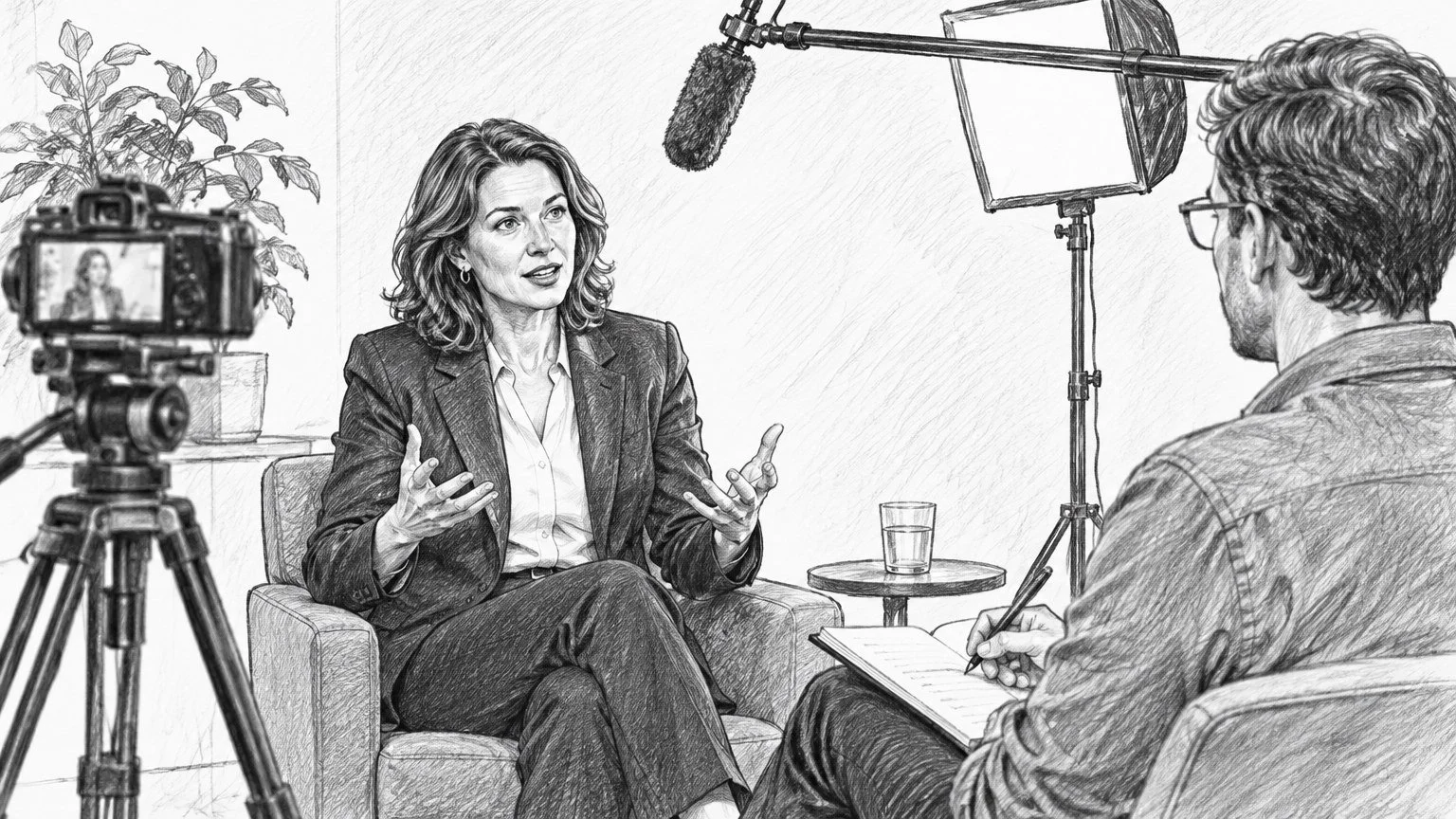
AI-generated storyboard illustration; a conceptual scene, not a client-production still.
The best preparation for an executive video interview is not a document full of polished sentences to memorize. It is a shared understanding of the audience, a small set of useful ideas, and specific experiences the speaker can explain in their own words. Prepare the substance; let the interview produce the language.
For a marketing director hiring a video production company, that means organizing a short pre-interview, identifying factual boundaries, and giving the director a usable subject brief. It also means protecting the executive from a crowded set and contradictory coaching. The goal is a clear, truthful conversation—not a performance that merely sounds unscripted.
This guide assumes the speaker has already been chosen. It addresses preparation and interviewing, not whether to cast an employee, customer, or professional actor.
Decide what this person can uniquely explain
Start with the speaker's actual knowledge. An executive may be well placed to explain a strategic decision, but less able to describe the details of a frontline workflow. Job title is not a substitute for firsthand insight. Choose the territory where this person's perspective adds something useful.
Write two or three audience questions the interview should help answer. For example: Why did the organization choose this direction? What tradeoff mattered? What should a prospective customer understand before making a decision? These are more useful than instructions to “communicate innovation and passion.”
Then identify the limits. Which subjects need another expert? Which facts require checking? Which topics should not be discussed? Give those boundaries to the interviewer before the day. Do not rely on an executive assistant to interrupt halfway through an answer because the filming team was never briefed.
Use a pre-interview to discover substance
Hold a bounded conversation before production, ideally with the person who will conduct or direct the filmed interview. Explain the purpose and intended use, explore what the subject knows, and listen for concrete examples. This is discovery, not a rehearsal of a final performance.
The National Park Service's oral-history interviewing guidance recommends preparation, pre-interviews, open-ended questions, listening, and follow-ups. Commercial interviews have different purposes from oral history, but those craft practices offer a useful foundation. They do not guarantee a persuasive result, and they are not a license to put words in a speaker's mouth.
During the pre-interview, note promising stories and explanations in ordinary language. Record what made them useful: a specific decision, a surprising constraint, a detail only this speaker would know. Ask permission before recording the preparatory conversation, and follow your organization's applicable processes for any recording and use.
Prepare talking territory, not approved sound bites
Give the executive a short preparation note. It should describe the audience, purpose, likely themes, and practical expectations. It can invite the speaker to think of examples without requiring exact phrasing.
A useful prompt is: “Think about one occasion when that decision changed what your team did.” A less useful prompt is: “Please say that our relentless innovation empowers transformational outcomes.” The first creates room for something specific. The second asks the subject to recite copy with conversational inflection.
If an exact statement is genuinely necessary, tell the production team. It may belong in a separate scripted passage, voiceover, or graphic rather than being disguised as an interview answer. Mixing mandatory copy and open conversation without naming the difference creates frustration for both the speaker and the editor.
Give the director a subject brief
The interviewer needs more than a list of approved themes. Prepare a compact brief containing:
Audience: who is watching and what they need explained.
Speaker's authority: what this person directly knows and why their perspective matters.
Useful examples: specific experiences raised in the pre-interview, with factual questions still to resolve.
Priority questions: a small number of questions essential to the film's purpose.
Vocabulary: technical terms, names, and abbreviations that may need explanation.
Boundaries: restricted subjects, unresolved claims, and the person who can answer factual questions.
Practical needs: pronunciation, access requirements, available time, and any agreed breaks.
Keep private information out of widely shared production notes unless the crew genuinely needs it. The brief should help the director conduct a respectful and productive conversation, not become an unfiltered personnel file.
Ask one question the speaker can actually answer
On camera, questions should be short enough to hold in mind. “What changed?” is often more productive than a four-part question asking for strategy, culture, customer impact, and future vision in one answer. If the first answer is broad, follow it with a request for an example or clarification.
Avoid loading the desired conclusion into the question. “How did this groundbreaking decision transform the company?” supplies both the judgment and the result. “What happened after that decision?” leaves the subject room to explain what actually occurred.
The interviewer can still guide the conversation toward the film's purpose. Open-ended does not mean directionless. It means allowing the speaker to supply the substance rather than requiring agreement with the interviewer's premise. Listen for an incomplete thought before moving to the next planned question.
Set up a useful eyeline and a calm room
Discuss with the director whether the executive addresses the interviewer beside the camera or speaks directly into the lens. Both approaches can work; switching unintentionally can make the finished sequence feel inconsistent. Explain the chosen approach in simple language rather than giving the speaker a technical lecture.
Limit the number of people coaching the subject. Appoint one client representative to communicate necessary factual corrections through the director. A semicircle of colleagues nodding, frowning, and offering new phrases can make it difficult for anyone to speak naturally.
Allow time to settle into the setup and check sound before using the executive's most constrained minutes. The production team should explain the microphone, interruptions, and what happens if a line needs repeating. These practical expectations are part of preparation, not a demand that the speaker become a professional performer.
Request clarity without manufacturing certainty
Sometimes an answer needs another pass because a pronoun has no context, an acronym is unexplained, or an interruption covered the key sentence. Explain the actual problem. “Could you name the process instead of saying ‘it’?” is more useful than “say it with more confidence.”
Do not turn a qualified observation into an absolute claim simply because the shorter version edits neatly. If the speaker says a result depends on a condition, preserve that meaning. Mark new factual assertions for the appropriate client review rather than assuming that seniority makes every statement cleared.
The earlier casting guide addresses the choice of speaker. The interview preparation task is narrower: create the conditions for that selected person to communicate something they actually know.
Plan coverage around the explanation
Ask the producer what supporting images the interview is likely to need. If the executive describes a process, can the film show the relevant action? If they discuss a decision, are there appropriate visual materials that make the explanation less abstract?
This is not a request to invent evidence for a convenient quote. Supporting footage should clarify the subject, not imply that unrelated images document the event being described. Where an illustration or reconstruction is proposed, discuss how its nature will be made clear.
Make these choices within the approved brand film approach. An interview cannot carry every kind of message equally well, and a last-minute demand for extensive additional footage can change the production assignment.
Review the edit for faithful meaning
At review, judge whether the assembled answer accurately represents the speaker's point. Removing repetition is different from joining fragments into a new assertion. Check that qualifications, sequence, and context still make sense in the finished construction.
Use the stage-by-stage edit review process to separate substantive concerns from minor preferences. A factual or meaning problem deserves a clear note explaining the issue; discomfort with one's own recorded voice is not the same category of problem.
Good executive preparation gives the production company useful material and gives the speaker a manageable task. Define the audience, find concrete substance, set honest boundaries, and let one prepared interviewer lead. The resulting conversation can be specific without sounding memorized—and the marketing team has a much clearer basis for deciding whether the final film says what the executive genuinely meant.