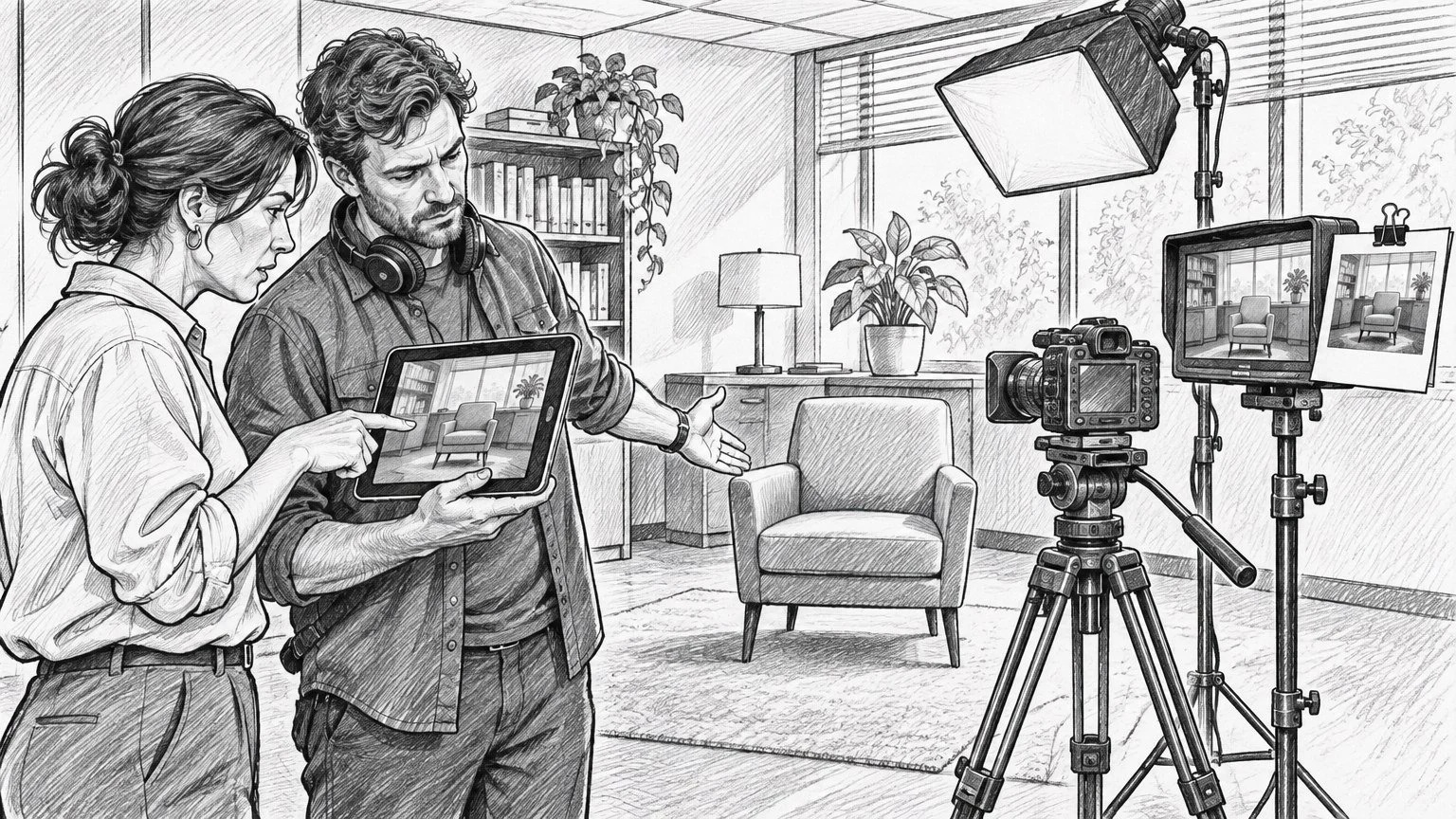
AI-generated storyboard illustration; a conceptual scene, not a client-production still.
Two locations can look different and still belong in the same film. The problem is not variation; it is accidental variation that distracts from the story. An executive framed tightly against a dark background may feel unrelated to a colleague filmed wide in a bright meeting room, even when both images are individually attractive.
For a multi-location commercial, ask your video production company for a repeatability brief before the first shoot. It should separate the visual rules that must travel from site to site from the details each location can contribute. Approve one representative setup, document how it was made, and review a small sample from each subsequent site before the crew completes its coverage.
This is particularly useful when a Dallas–Fort Worth marketing team coordinates branches, facilities or regional offices whose filming dates and local crews differ. A shared brand guide is a starting point, not a complete filming specification.
Decide what should match and what should remain local
Begin with the audience's experience. Are several offices meant to feel like one organization? Are locations being compared? Or does the story deliberately move through distinct communities? Those intentions create different consistency requirements.
For a unified leadership film, matching interview scale, eyeline and sound may matter more than matching architecture. For a process comparison, viewers may need the same action filmed from comparable positions. For a regional recruitment film, suppressing every local difference could remove the most interesting evidence.
Make two lists. The first contains invariants: characteristics that remain stable unless someone authorizes an exception. The second contains local choices: details the on-site filmmaker can adapt. Keep both short enough to use while working. “Make it cinematic and on brand” does not distinguish a deliberate decision from an avoidable mismatch.
This differs from deciding whether to film on location or in a studio. Here, the locations are already part of the assignment. The task is to make their footage work together.
Build a reference packet, not a mood-board collection
A collection of beautiful images can communicate taste without communicating a repeatable setup. Give the production lead a compact reference packet with an annotated frame, a short approved interview sample, and a small group of representative action shots.
For an interview, document the decisions that change how people relate on screen:
Frame: approximate subject size, headroom and whether hands are visible.
Eyeline: who the subject addresses and which side of the lens they face.
Background: desired depth, activity and excluded distractions, rather than one impossible-to-recreate room.
Light: the intended direction and contrast, with a visual reference instead of adjectives alone.
Sound: microphone approach, expected room character and an example of acceptable speech clarity.
Movement: locked camera, restrained movement or another clearly described approach.
Interview method: how questions are asked and whether answers must make sense without hearing the prompt.
Let the cinematographer translate those intentions into appropriate equipment and settings. Do not turn a buyer's checklist into unsupported instructions that every room must use the same lens, exposure or lighting arrangement. Identical settings in different conditions do not automatically produce matching pictures.
For one technical example, Canon explains custom white balance as calculating and applying a color shift from a neutral white reference. That supports documenting reference conditions—not copying identical settings into differently lit rooms.
Give one person ownership of the cross-site look
Someone must see the whole film before it exists. Name a production-side visual lead who owns the reference packet and resolves exceptions. Local crews need a reachable person, not several stakeholders with different interpretations of the brand.
On the client side, appoint one marketing owner who can distinguish a genuine brand requirement from a local preference. A branch manager can identify an inaccurate process or inappropriate background. That does not necessarily make them responsible for changing the campaign's visual language.
Write down how a local concern reaches the central team and how quickly a decision is needed. If a room cannot reproduce the reference, the filmmaker should be able to propose a controlled alternative. The answer might be a tighter frame, a different background or a deliberate visual transition, rather than hours spent forcing an unsuitable space to comply.
Set these responsibilities within the overall commercial production timeline. Waiting for the visual lead to review five completed shoots defeats the purpose of having that role.
Approve a pilot setup before repeating it
Treat the first representative location as a test of the system. Review a short sample while adjustments are still practical. Include a complete answer with sound, not merely a silent frame grab. A still can conceal echo, mechanical noise, distracting movement and an awkward interview rhythm.
Ask three questions. Does this sample communicate the intended level of formality? Can other locations reproduce its important characteristics without unreasonable disruption? Will it cut naturally with the planned action footage and graphics?
Do not approve an unusually elaborate flagship setup if ordinary branches cannot support it. A repeatable standard is often more useful than an exceptional first image that becomes an expensive obligation elsewhere.
Once approved, record the sample's version and the decisions it establishes. If the team later changes direction, identify which future sites adopt the change and whether earlier footage needs attention. Otherwise, an informal improvement halfway through production can create two incompatible visual systems.
Specify coverage by editorial function
Interviews alone rarely give an editor enough material to move comfortably between locations. Plan corresponding coverage families: people arriving, a task beginning, an interaction, a detail, an outcome and a sense of place. Each family should have an editorial purpose.
For example, a fictional service organization might need an employee receiving a request, checking information and handing a result to a colleague. The exact desks can differ. The sequence remains understandable because the action has a beginning, middle and end at every site.
Avoid demanding literal duplicates where they would be artificial. If one branch serves customers in person and another works remotely, show the real distinction. Consistency should clarify the organization, not manufacture evidence that all locations operate identically.
Record gaps explicitly. “No customer interaction available at this site” gives the editor useful information. An unlabeled folder of attractive empty-room shots does not explain what was unavailable or why.
Use a site-to-site acceptance card
Before each crew leaves, check a bounded sample against the approved reference. This is not a remote committee reviewing every take. It is a small repeatability check with an identified decision-maker.
Use this copyable acceptance card:
Site and date: identify the actual location and filming session.
Reference version: specify the approved sample the crew used.
Interview sample: check frame, eyeline, answer completeness and intelligibility.
Action sample: confirm that the required coverage families exist.
Exceptions: state what differs, why and who accepted it.
Unresolved gap: identify the missing action or information, not merely “more B-roll.”
Editorial note: flag local names, process differences or factual context the editor must preserve.
Release decision: name the person confirming that the agreed capture scope is complete.
Keep the check proportional. If a minor furniture difference will not affect comprehension, do not spend the final hour correcting it while an essential action remains unfilmed.
Plan for different crews without pretending they are interchangeable
Using one traveling core team can reduce interpretation differences, but travel is not automatically the best answer. Availability, access windows and geographic spread may favor local crews. Ask the production company to explain the coordination method, not simply promise that everyone has professional equipment.
Local crews need the same brief, reference material, interview method and delivery expectations before arriving. The central editor also needs a predictable organizational structure and a clear way to ask questions after the shoot. Separate this acquisition plan from the later raw-footage and project-file handoff; both matter, but organizing files cannot repair an absent scene.
If a required match cannot be achieved, choose deliberately between adapting the visual rule, presenting the site as a distinct chapter or changing the capture plan. Document any scope consequence rather than allowing an exception to become an unnoticed expansion of work.
Final decision: standardize the important relationships
The goal is not seven identical rooms. It is a film in which viewers understand why each location appears and can follow the people, ideas and actions without being distracted by arbitrary shifts.
Before approving a multi-location production plan, look for four concrete things: a short list of invariants, one usable reference packet, named cross-site decision owners and a sample-based acceptance check before each crew wraps. Those controls leave room for local judgment while protecting the coherence the finished film needs.