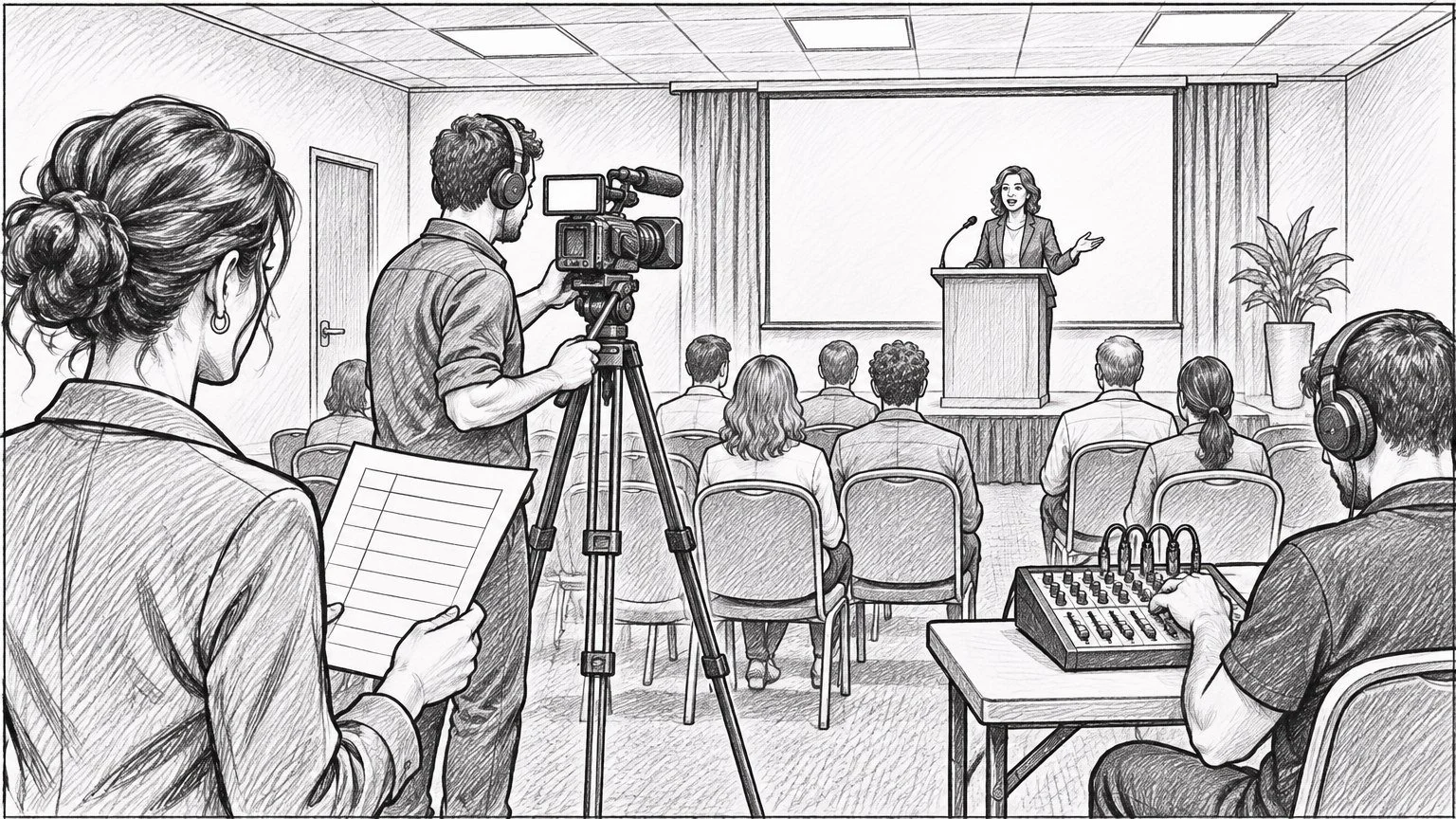
AI-generated storyboard illustration; a conceptual scene, not a client-production still.
A live event does not wait for a camera change. If the award presentation, product reveal or closing statement happens while the operator is elsewhere, the editor cannot recreate the missing moment from general room coverage.
Before hiring a video production company to film an event, build a must-capture plan: the exact moments and spoken material the finished deliverables depend on, where each happens, who controls access, how usable audio reaches the recording team and what takes priority when activities overlap. Attach that plan to the event's current run of show and give one person authority to resolve conflicts.
The purpose is not to prescribe a camera package or design the venue's AV system. It is to make the buyer's expectations executable before the doors open. A recap, a complete session recording and an interview-led event film are different capture assignments, even when they happen in the same room.
Name the output before listing the moments
Start with the required viewing experience. A complete session recording needs continuity: the presentation must remain understandable through its beginning, transitions, questions and ending. A short recap can be selective, but still needs the specific proof and spoken material that will support its story.
An interview-led film adds another dependency. Someone must arrange access to the right people at an appropriate time and in a place where an intelligible conversation is possible. A camera operator cannot simultaneously guarantee uninterrupted stage recording and leave to conduct an unscheduled interview unless the staffing and capture design support both.
List each required output separately. Identify its essential content and the standard for completeness. “Film the conference” is not an acceptance criterion. “Record the opening keynote continuously, including audience questions with understandable audio” gives the production partner a concrete problem to solve.
Version and distribution planning can follow the existing cutdown and vertical-deliverables framework. First establish what source material must exist at all.
Rank moments by the cost of missing them
Do not label every item essential. If the team has ten simultaneous priorities, it has no usable priority system. Classify capture requests into three levels:
Non-repeatable essentials: moments or statements without which a promised output fails.
Planned supporting material: useful actions, room context and interactions with known opportunities to capture them.
Opportunistic material: valuable additions that must not displace essential coverage.
Within the first category, identify the actual dependency. Is it seeing a recipient receive an award, hearing the announcement, capturing an audience reaction or recording the sponsor identification? Those are separate tasks, and the production team may need different positions or sources for them.
If two essentials overlap, resolve the conflict before the event. Add an appropriate resource, revise the deliverable expectation, arrange another legitimate capture opportunity or explicitly choose which moment wins. Do not leave that decision to whoever happens to be closest to the camera.
Turn the run of show into a capture document
The event organizer's run of show describes how the event operates. The capture plan adds what the video team needs to do within it. Keep the documents connected rather than maintaining conflicting schedules in separate email threads.
For each essential item, record the room, expected start, likely duration, stage or activity position and the person who can communicate changes. Include practical movement time between spaces. Two sessions ending and beginning at the same minute in different rooms are not automatically achievable by one crew.
Ask the organizer how updates will reach production. A changed speaker order can be harmless if the operator hears about it in time and costly if the team discovers it from the audience. Identify one live source of truth and a communication method appropriate to the venue.
The commercial AV provider SmartSource's event AV guide recommends incorporating AV requirements into the run of show and planning space for equipment and production staff. That is a useful coordination principle, not proof that a particular equipment list will suit every event.
Specify the audio handoff with the venue team
“There will be microphones” does not establish that the recording crew will receive usable audio. The house system's job is to serve the room. The recording assignment may require a separate agreed handoff, appropriate connections, monitoring and a plan for sources that do not pass through the house system.
Arrange a conversation between the video production lead and the responsible AV contact. The buyer should make the introduction and communicate the required outputs; the technicians should determine the actual signal arrangement and equipment compatibility.
Ask them to confirm which sources are included: lectern, handheld microphones, panelists, playback, remote participants and audience questions. Also ask what happens if a question is shouted without a microphone or a speaker begins away from the lectern. The answer may involve an event-host instruction rather than another piece of recording equipment.
Build a test into the schedule before essential coverage begins. Confirm that someone listens to the recorded result, not merely watches a meter move. Record the remaining limitations so the marketing team understands what is and is not being promised.
Confirm access, positions and permissions
A useful camera position is one the crew can actually occupy throughout the required moment. Confirm sightlines, seating restrictions, stage access, cable routes and any limits on movement with the appropriate venue and organizer contacts.
Do not assume the marketing team's invitation overrides a venue rule, speaker agreement or organizer restriction. Establish who is responsible for confirming permission to record and use the intended material, and route uncertainty to the relevant authorized reviewer. This checklist is operational guidance, not a legal determination of consent or rights.
Show the production company the actual room arrangement where possible. A floor plan can reveal that an intended camera position blocks an aisle or that an essential demonstration faces away from the audience. Fixing that relationship before the event is more useful than asking an operator to improvise around it during a live reveal.
Separate recording from live streaming. If streaming is required, scope its engineering, connectivity, monitoring and responsibility explicitly rather than treating it as a minor addition to a camera assignment.
Protect the interview window
If the deliverable depends on interviews, assign a client-side coordinator to secure people and bring them to the agreed place. Supply names, roles, pronunciation notes, factual context and a short list of the ideas each conversation must establish.
Avoid making an essential interview contingent on “catching someone during a break.” The speaker may be unavailable, the break may disappear or the surrounding space may be unsuitable. Where a firm appointment is impossible, agree on a fallback person or revise the story's dependency.
Use the principles in preparing executives for video interviews for substantive answers. The event-specific issue is access and timing, not teaching an operator to extract an entire campaign message from an unbriefed guest in thirty seconds.
Copy this must-capture brief
Give the producer one concise record for each essential moment:
Deliverable served: session recording, recap, interview-led film or another defined output.
Required evidence: the exact action, statement or information that must be captured.
Priority and conflict rule: what wins if another activity overlaps.
Place and time: room, position, expected start and relevant movement time.
Event contact: the person controlling the activity and communicating changes.
Capture responsibility: the production role accountable for coverage.
Audio source: agreed handoff and any known exceptions.
Access and permission: responsible approver and unresolved restrictions.
Fallback: the legitimate alternative if access, timing or equipment fails.
Completion note: what was captured, missed or changed.
Walk through the brief with the producer and event organizer together. Their questions often expose a conflict that neither would see from separate documents.
Close the event with a coverage report
Before the crew departs, reconcile the essential list against what actually happened. Flag missed lines, changed speaker names, absent interviews and audio limitations. Do not let the editor discover those gaps after stakeholders have already been promised a particular scene.
If the required output changes, use the agreed production scope-change process. Keep the explanation factual: what changed, which deliverable is affected and what options remain.
A strong event brief does not promise that nothing will change. It gives the production company and client a shared way to respond when something does. The result is an accountable capture assignment, rather than a general request to be everywhere and return with a film.