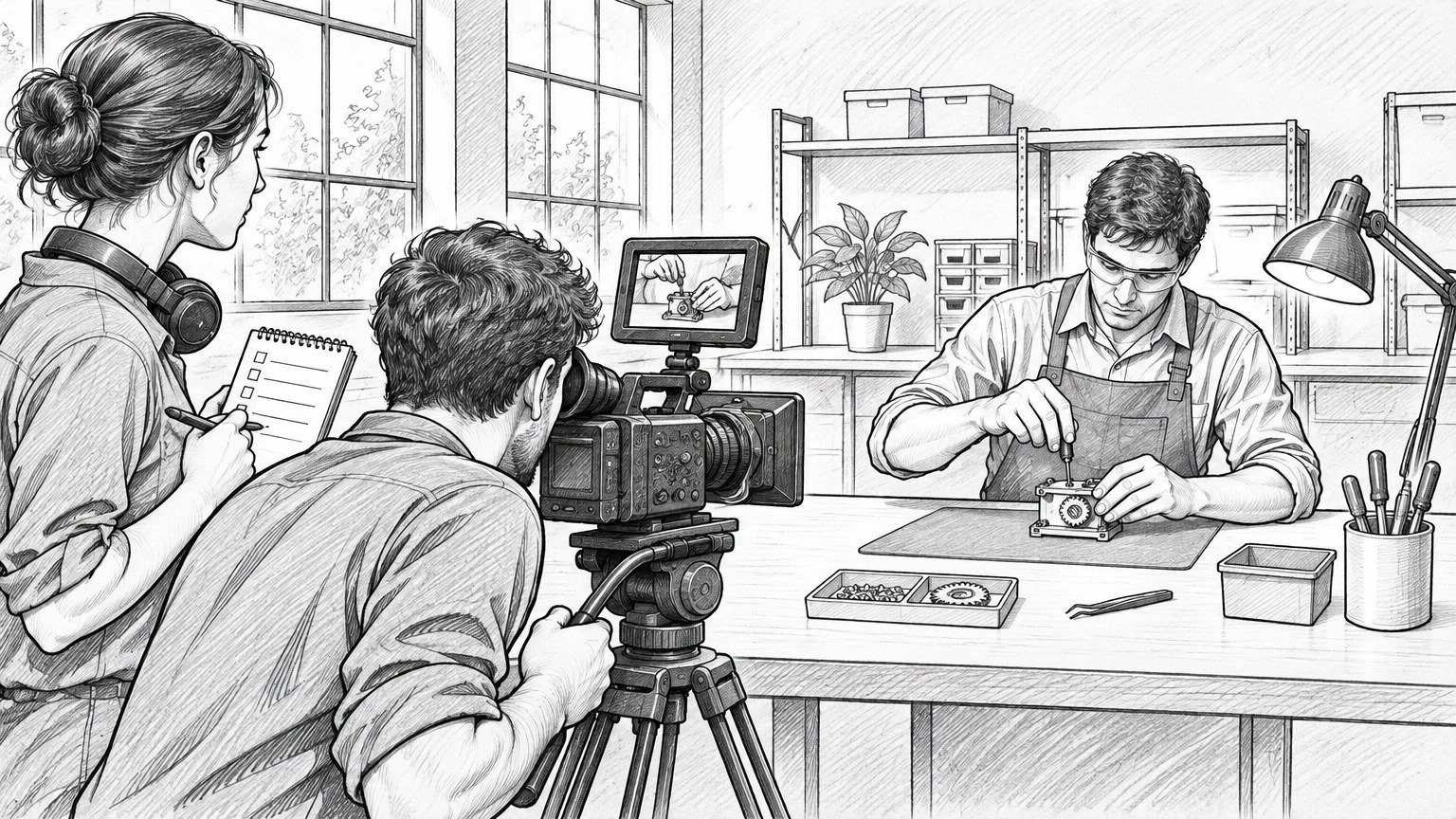
AI-generated storyboard illustration; a conceptual scene, not a client-production still.
A folder containing hundreds of attractive shots is not automatically a useful footage library. The team may be unable to find the right action, determine whether a person can still appear in a new campaign or identify which product version is shown. Receiving more files does not solve those problems.
When commissioning a B-roll library, specify repeat-use situations, shot families, searchable descriptions and the conditions that limit future use. Then test whether a person who was not on the shoot can find and correctly use representative material. The assignment is to create a usable marketing resource, not merely accumulate footage left over from a single film.
This guide addresses acquisition and library utility. Questions about ownership, transfer formats and editable projects belong in a separate raw-footage and project-file handoff agreement. A well-organized delivery still needs useful content; useful content still needs an appropriate agreement.
Define the next users before the next shoot
Identify who will use the library: an in-house editor, a social team, an agency or another production company. Ask those users what they repeatedly struggle to find. “More people footage” is not specific enough to guide an acquisition day.
Translate recurring requests into situations: introducing a new location, explaining a service step, illustrating a recruiting message or showing a product in ordinary use. Name the future need without pretending the team can predict every campaign.
For each situation, identify the visual evidence required. An empty office establishes a place. It does not establish collaboration. A close-up of hands can show a task, but may not identify who performs it or what the result means. A useful library contains combinations that support an understandable statement, rather than isolated images that simply share a subject.
Set a boundary around the intended life of the resource. A library for one product release has different requirements from material intended to support several years of organizational communication. Longer intended use increases the importance of identifying details that may become inaccurate or inappropriate.
Commission shot families rather than a miscellaneous list
A shot family is a connected group of images serving one recurring use. It might include the environment, the person doing the work, the action itself, a useful detail and the result. The exact family depends on the task; it is not a universal five-shot formula.
For a fictional repair service, one family might show a request being received, an item being inspected, a technician using an appropriate tool and the completed item being checked. Each shot contributes to the same usable idea. The production team can then judge what variations add value.
Specify meaningful alternatives, not quantity for its own sake. A clean version without a prominent temporary campaign sign may have greater future utility than another similar angle. A version with space for an eventual title may help one use; a neutral composition may serve another. Discuss those intentions rather than requesting every possible framing at every moment.
Distinguish this from making predetermined cutdowns and vertical versions. A library supports future assembly whose message is not fully decided yet. It should not be sold internally as a guarantee that any future brief can be built without another shoot.
Separate enduring evidence from time-sensitive material
Some images age because the world changes. Uniforms, packaging, interfaces, signage, equipment and staff can all make a shot unsuitable before its technical quality deteriorates. Identify those dependencies while the team still knows what it is filming.
Use practical categories such as enduring, review-before-reuse and campaign-specific. These are editorial handling instructions, not legal conclusions. A technically timeless image can still have restrictions under the actual participant, location or other relevant agreements.
Assign a client-side owner to determine which people, processes and products can be filmed for the intended uses. The production company should know what authorization it is expected to arrange and what the client supplies. Do not assume that permission for one finished film automatically answers every future-use question.
Where an image depends on a particular product configuration or business claim, record enough context to avoid misleading reuse. A shot demonstrating one model should not quietly become evidence for a different model because the files look similar.
Design metadata that a future editor can search
Metadata is useful information associated with footage. It can live in an agreed index, asset-management system or another practical structure. The system matters less than whether the receiving team can use and maintain it.
Ask for a small required field set. More fields are not automatically better; a complex taxonomy that nobody completes is less useful than a modest accurate index. Consider:
Stable asset ID: a reference that remains usable if a display name changes.
Location and capture date: where and when the image was made.
Subject and action: what a viewer actually sees, in ordinary searchable language.
Shot family: the related sequence or recurring use it supports.
People or product reference: an approved internal identifier, avoiding unnecessary personal data.
Use conditions: a pointer to the responsible rights or permission record, not sensitive paperwork copied everywhere.
Review trigger: a date or business change that requires another check.
Technical note: a meaningful limitation such as an incomplete action or an image intended for slow playback.
Selection status: approved library select, alternate or excluded material.
Agree on vocabulary with the actual users. A filmmaker's poetic description may be less searchable than “technician inspects valve.” Keep subjective judgments separate from observable content.
Adobe's B-roll guidance recommends planning needed footage with a shot list. For a commissioned library, extend that planning beyond the current film: identify how future users will retrieve each planned family and recognize its limitations.
Decide what the receiving team should not receive as ready-to-use
An acquisition day can produce tests, interrupted actions, unapproved experiments and near-duplicates. Decide whether the library assignment includes selecting usable takes, supplying every recorded file or both in clearly separated structures.
Do not label an entire camera card “approved” simply because some footage on it is useful. Conversely, do not discard source material without the agreed retention and delivery instructions. The buyer and production company should define those responsibilities before the handoff.
If a shot contains a known limitation, make that limitation visible at the point of use. A note buried in a delivery email is unlikely to protect an editor who downloads the clip months later through a different colleague.
Keep confidential or unsuitable material out of the general-use library. Use the existing information-control checklist to prevent sensitive screens, papers and background details from becoming an unexpected reuse problem.
Accept the library through real retrieval tasks
Do not evaluate a library only by playing a polished montage. A montage demonstrates that someone familiar with the footage can make a montage. It does not demonstrate that a future user can locate the material they need.
Choose several representative tasks before delivery. For example: find an approved sequence showing a service handoff; identify a neutral exterior with no temporary sign; locate the current product version; determine whether a named employee's footage requires another review.
Have a receiving editor or marketing user perform those tasks with the delivered system and documentation. Observe where they hesitate. The problem may be missing footage, unclear descriptions, an inaccessible index or uncertainty about permissions. Each needs a different fix.
Use the test to agree on specific acceptance corrections. Avoid turning acceptance into a new creative brief for footage that was never commissioned. If an important use was omitted from the original scope, acknowledge it as a gap to plan rather than assuming the existing files must contain an answer.
Give the library an owner after delivery
Name the person who updates use conditions, archives superseded versions and routes uncertain reuse decisions. Without ownership, even an excellent initial library gradually becomes a mixture of current, outdated and unexplained material.
Define business triggers for review: a rebrand, a product redesign, an employee change or a process revision. Do not invent a universal expiration period. Different assets age for different reasons, and the relevant agreements and facts control their appropriate use.
Record requests the library cannot satisfy. Those requests become evidence for the next acquisition brief. They are more useful than a vague impression that the organization needs another day of “general B-roll.”
Final commissioning decision
Before approving a library shoot, ask for five things: named future users, a prioritized set of recurring uses, planned shot families, a maintainable information structure and a retrieval-based acceptance test. Resolve delivery and reuse responsibilities through the actual agreement.
The measure of success is not how many gigabytes arrive. It is whether the next authorized user can find the right evidence, understand its limitations and make a sound production decision without reconstructing the shoot from memory.