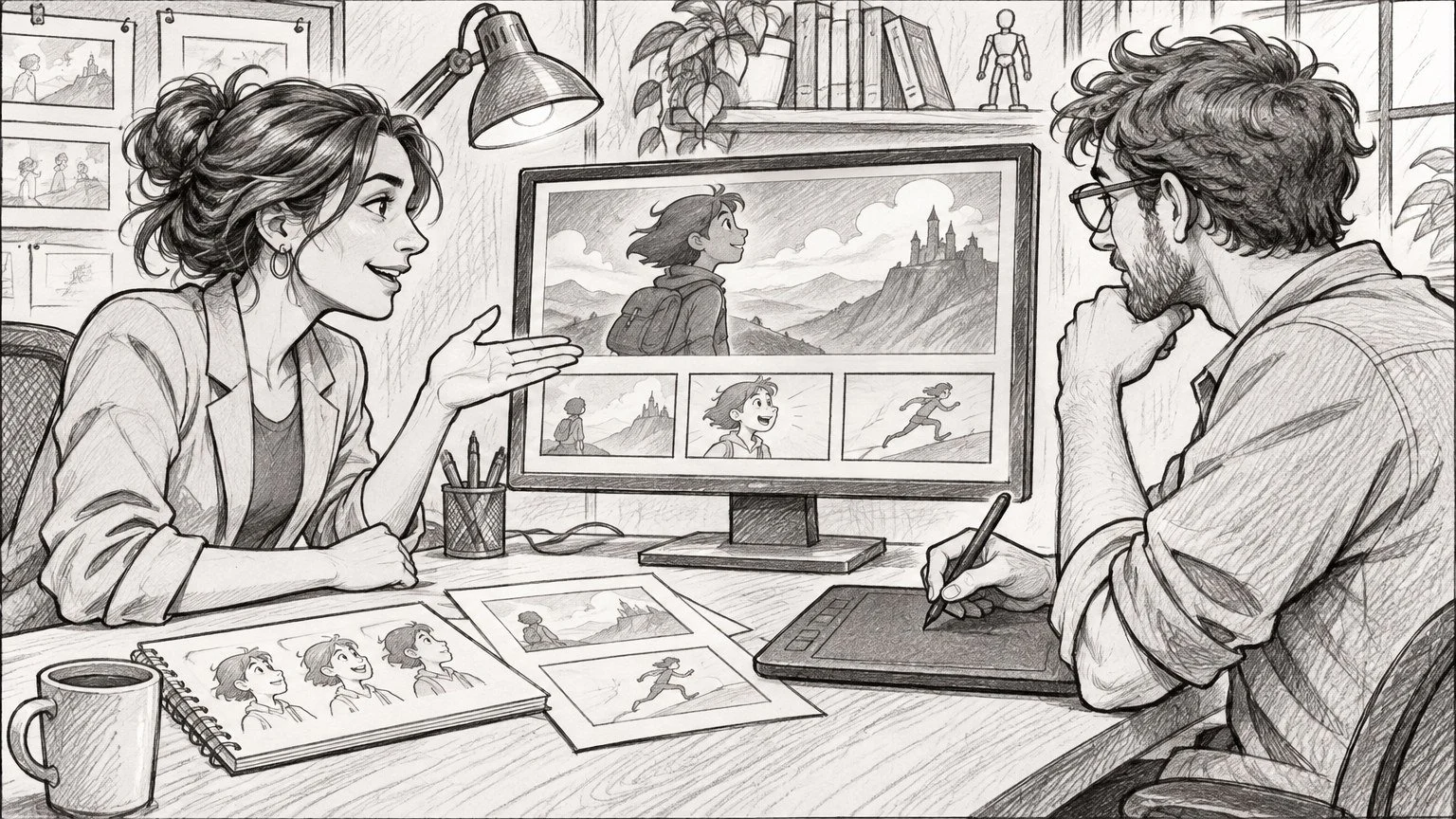
AI-generated storyboard illustration; a conceptual scene, not a client-production still.
Animation makes almost anything appear possible. That flexibility can hide a practical constraint: a seemingly small decision may affect many connected frames, scenes and sound cues once production is underway.
When commissioning animation, approve the work through artifacts that answer different questions. The script establishes meaning, style frames establish appearance, the storyboard establishes visual explanation and the animatic tests sequence and timing. Approving one does not automatically approve the others. Ask your production partner to name what each stage commits, what remains provisional and which later changes would require revisiting earlier work.
This is an animation-specific buyer framework, not a rule that every studio uses identical terminology. A simple motion-graphics piece may combine stages; a complex character film may require additional tests. The important control is visible decisions before expensive dependencies accumulate.
Begin with the thing the audience must understand
Write the viewer's required takeaway before discussing visual style. Is the animation explaining a mechanism, distinguishing two services, showing a sequence or making an abstract relationship visible? “An engaging explainer” is a category, not a communication objective.
Ask what the viewer already knows. A diagram for technical buyers can rely on different assumptions from an introductory brand film. Decide which terms need definition, which steps cannot be omitted and which simplifications would become misleading.
For a fictional software process, showing a request move directly to completion might make a complicated sequence understandable. It might also erase an essential human approval. The responsible product expert should identify that distinction before the animator invests in a convincing visual explanation of the wrong process.
If the proposed film makes factual assertions, use the same claim-evidence discipline as live action. A diagram can communicate a claim even without a spoken sentence.
Approve the script as a visual argument
An animation script should establish not just what is said but what must be shown. Ask the production company to connect narration, on-screen text and the intended visual idea. This exposes passages where the picture merely repeats the voice or where two competing explanations overload the viewer.
Do not demand that every visual detail be solved at script stage. Do require agreement on the argument: what happens, why it matters and what the viewer should conclude. Identify exact terminology, necessary qualifications and the owner of technical accuracy.
Read the script aloud against a plausible duration. If the film has to explain five unfamiliar ideas in a short placement, adding faster transitions will not necessarily make the audience understand them. Reduce or reorganize the message before detailed visual production begins.
Record which script elements are locked and which remain open for visual exploration. A change in the central explanation later is different from a revised transition, even if both arrive as a one-line comment.
Use style frames to test a system, not a favorite image
A style frame is a representative designed image. Review it for the visual language the film will use: typography, shapes, illustration, texture, color relationships and the treatment of information. A beautiful opening frame may not demonstrate whether the style can explain the hardest part of the story.
Ask to see a representative challenge. If the film includes a dense process, an interface and a human character, review enough examples to understand how the proposed system handles those needs. Do not approve a minimal brand card and assume it resolves every later scene.
Separate taste from function. A restrained visual style can still be unreadable if labels are too small or relationships are ambiguous. Conversely, a style that differs from a stakeholder's preferred reference may communicate the actual subject more clearly.
Capture approved principles in words as well as pictures. For example: “Use simplified diagrams rather than literal interface reproductions; preserve the named approval step; use one emphasis treatment for active elements.” That record helps prevent each new scene becoming another open-ended style debate.
Read the storyboard for cause and effect
The storyboard lays out what appears and how the sequence progresses. At this stage, assess whether the audience can follow the explanation. Do not judge unfinished drawings as though they were final illustrations.
For each scene, ask what changed from the previous one, why the change matters and what carries the viewer into the next scene. If an object transforms, is the relationship clear? If the camera appears to travel into a diagram, does the viewer retain a sense of where they are?
Check the relationship between labels and the things they identify. A familiar product expert may mentally supply a connection that a new viewer cannot see. Invite a reviewer who understands the audience but has not lived inside the project to explain the sequence back in plain language.
Keep this review distinct from the broad creative-treatment approval. The treatment tests whether the concept deserves production. The storyboard tests whether the chosen concept is being explained scene by scene.
Watch the animatic without imagining the missing clarity
An animatic places storyboard images into a timed sequence, often with temporary narration and sound. Its value is testing duration, pacing and comprehension before the finished motion is built. Temporary quality is expected; an unresolved explanation should not be excused as temporary polish.
Watch it once without stopping. Can you follow the argument at viewing speed? Then inspect the difficult moments. Does text stay long enough to be read alongside the narration? Does an important transition happen before the viewer understands the preceding state? Is the ending given enough room to resolve?
Ask the production team to identify what the animatic cannot demonstrate. A complex character performance, simulation or transition may need a separate motion test. Agree on that uncertainty rather than approving a rough sequence on an unsupported promise that every concern will disappear in animation.
A timing approval should also identify the status of the voice and music. Replacing temporary narration with a substantially different read can affect scene duration, pauses and emphasis. Avoid treating sound as an entirely independent finishing layer when the images are built around it.
Adobe describes animatics as animated storyboards that help test timing, flow and whether a sequence communicates at the intended pace. The approval record should state which of those questions this particular version actually answers.
Make approval specific enough to use
At each stage, send a short decision record with these fields:
Artifact and version: exactly what the team reviewed.
Question answered: meaning, appearance, sequence, timing or a named technical uncertainty.
Approved elements: decisions that downstream work may rely on.
Open elements: clearly bounded matters still being explored.
Factual reviewer: the person confirming the explanation's accuracy.
Client decision owner: the person consolidating stakeholder feedback.
Next dependency: the production work that begins after approval.
Change consequence: what must be reconsidered if an approved element changes.
Avoid “approved, except for the story” or similar contradictory approvals. If the unresolved issue affects the foundation, acknowledge that the gate remains open. If a small independent detail can be deferred safely, name it precisely.
Distinguish correction from a changed instruction
When feedback arrives later, compare it with the actual approved artifact. A label misspelled relative to approved copy is a correction. Replacing the explanation with a new process is a changed instruction. A transition that does not work as demonstrated may need another discussion about what was reasonably established.
The purpose is not to win an argument about blame. It is to identify a workable next action and its effect on time and scope. Use the agreed change-order framework when a new instruction creates additional work.
Do not assume that a small screen area means a small revision. A changed object can affect its appearances across multiple scenes; a rewritten sentence can alter timing throughout a sequence. Ask for an explanation of dependencies rather than accepting or rejecting the impact based on visual size alone.
Final checklist before finished motion
Before authorizing the main animation stage, confirm that the team has an approved visual argument, representative style, understandable scene sequence and a timing test that the actual audience can follow. Name any additional motion tests and unresolved factual questions.
Then let the animators animate. Clear early decisions should reduce avoidable rework, not turn every frame into a committee vote. The strongest approval process protects both the buyer's message and the production team's ability to execute it with intention.