Brand Film Production: What Marketing Directors Should Decide Before the Camera Rolls
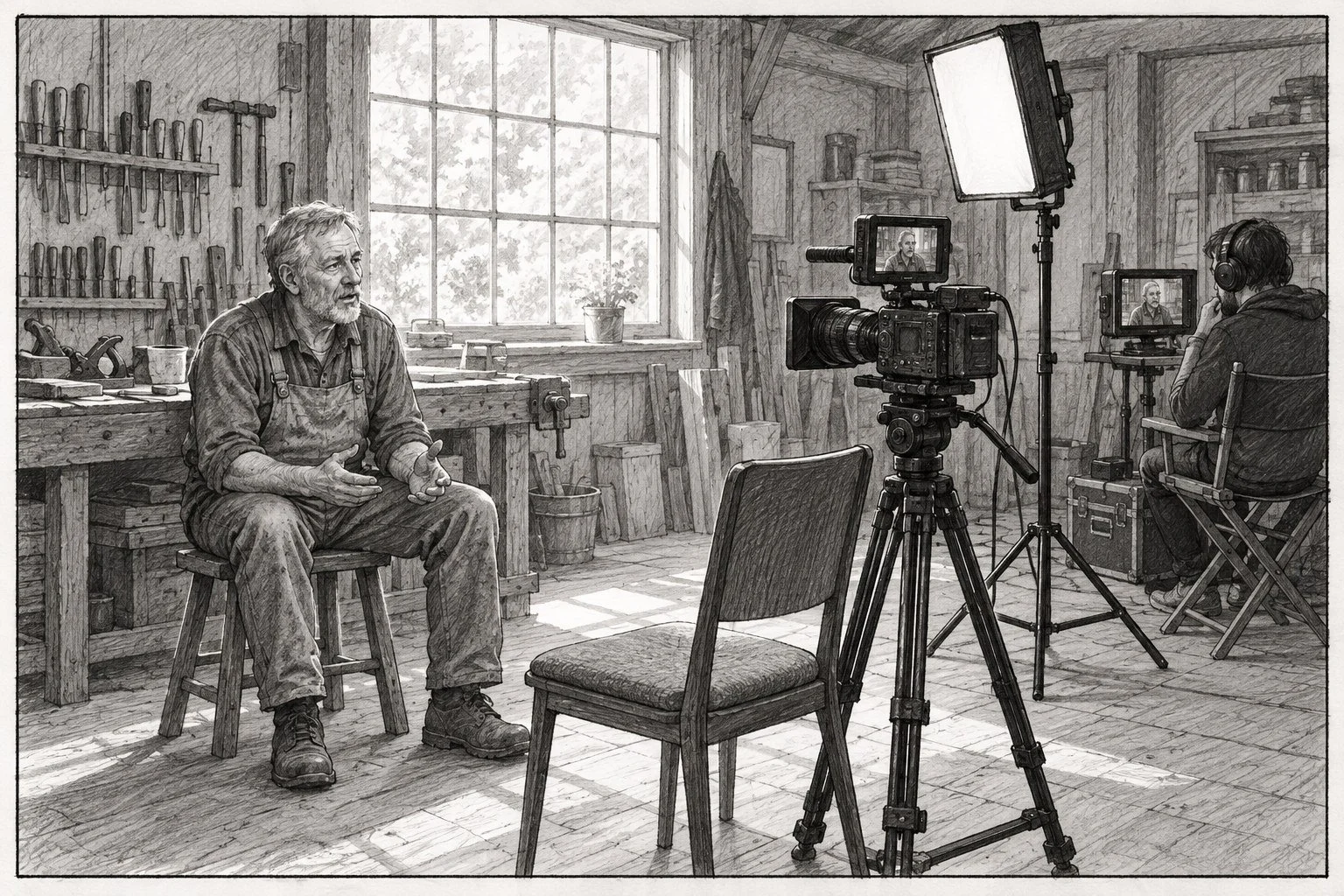
AI-generated storyboard illustration; a conceptual scene, not a client-production still.
A brand film tells a story about what a company believes, who it serves, or why its work matters. It doesn't walk through a product's features. That difference changes how the film gets made. In a typical commercial, the story is written, approved, and then shot. In a brand film, the story is often found: in interviews, in real places, and in the edit. So the most important decisions come before production: which approach you're taking, where the story will come from, who approves what and when, and where the film will run. Get those four right and the rest of brand film production becomes much easier to scope, budget, and judge.
How a brand film differs from a commercial
A commercial usually has one job: get a defined audience to take a defined next step. A brand film has a slower job. It gives people a reason to care about the company before they compare options. That's why brand films run longer, rely more on real people, and are judged on whether viewers stay with them, not only on clicks.
If you're still deciding between the two formats, start with which to make first: a brand film or a product video. This guide assumes you've decided a brand film is the right tool and need to commission one well.
A useful reference point is BMW's The Hire, a series of eight short films released online in 2001 and 2002 and directed by filmmakers including John Frankenheimer, Ang Lee, Wong Kar-wai, and Guy Ritchie. The cars mattered, but the films were built as stories first. More than twenty years later, it's still the standard example of a brand trusting the story to carry the brand. It also offers a less-quoted lesson about rights, covered below.
Decision 1: Choose the production approach
Almost every brand film falls into one of three approaches. Each trades control for authenticity differently, and each changes the crew, schedule, and edit.
Scripted
Actors, a written script, and a shot list. You approve the words before anyone films them, which gives you the most control and the most predictable edit. The tradeoff is that scripted brand films can feel like advertising wearing a costume. They also add casting, talent fees, wardrobe, and usage terms. Choose scripted when the idea depends on a performance or a fictional situation the company can't film for real.
Documentary
Real employees, customers, or partners, filmed in real places, with the story shaped from interviews and observed moments. It carries the most credibility, especially in industries where buyers distrust polish, such as agriculture, construction, manufacturing, and outdoor gear. The tradeoff is less control: you can't approve answers in advance, and the final structure is settled in the edit. Plan for more interview time, more footage, and more editing time than a scripted film of the same length.
Hybrid
A documentary core built around real interviews, with written or staged scenes for the moments that are hard to catch live: a sunrise drive to a job site, a hand on a tool, a family at a table. Most strong brand films end up here. The rule that keeps hybrid honest is simple: stage visuals, never testimony. Real people should speak in their own words. Directed scenes can recreate things they actually do, but should not invent claims or feelings.
Decision 2: Decide where the story comes from
Documentary and hybrid films live or die on who's on camera. That choice deserves a real process, not whoever happens to be free on the shoot day.
Discovery calls. The production team talks to several candidates before choosing anyone. Ten or fifteen minutes on the phone reveals who tells a story with specifics and who speaks in generalities.
Pre-interviews, not scripts. Nobody should get their lines in advance. A rehearsed answer sounds rehearsed. A good director uses the pre-interview to learn which stories exist, then asks for them fresh on camera.
Approve themes and questions, not answers. Your legal or communications team can and should review topics, claims that need substantiation, and anything off-limits. They shouldn't write what a customer is going to say.
Shoot people doing their work. An interview is the backbone. What people actually do on camera is what makes viewers believe it.
The craft here is old and well documented. Documentary director and editor Roger Nygard's ten rules for documentary interviews includes keeping the interviewee's eyeline close to the lens and letting silence work after each question. It also recommends asking for a specific example whenever an answer comes out general. In the same piece, Errol Morris describes his "Interrotron," a mirror rig that lets subjects look straight into the lens while seeing the interviewer. When you evaluate a production company, ask how it runs interviews. The answer tells you a lot about whether real people will sound like themselves.
Decision 3: Set approval gates for each phase
Brand films run into trouble when approvals happen too late, usually when a stakeholder sees a near-final cut and asks for a different story. Agree on the gates up front:
Creative brief: objective, audience, the one thing viewers should feel or believe, mandatory and forbidden topics, where it will run. You approve the strategy.
Treatment: approach, tone, story outline, visual references, candidate subjects and locations. You approve the direction. This is the last cheap moment to change course.
Pre-production: schedule, crew, locations, interview questions, release forms, safety and access plans. You approve logistics and question topics.
Production: a client representative on set or on a monitor, with one person empowered to make calls. You approve in the moment, sparingly.
Story edit: a rough assembly or "radio cut" built mostly from interview audio, before visual polish. You approve the story itself. Most structural changes belong here.
Fine cut and finishing: pacing, music, color, sound mix, graphics, captions. You approve refinements, not a new story.
The story-edit gate is the one most often skipped, and skipping it is the most expensive mistake. In documentary work the story is assembled in the edit. If the first story your team sees is already color-graded and scored, every change costs more.
For outdoor and on-site shoots, whether ranches, plants, or job sites around Dallas–Fort Worth, put a backup plan into the pre-production gate too. Our guide to asking for a weather plan covers who has the authority to call it.
Decision 4: Plan distribution and rights before you shoot
A brand film's length, structure, and rights should follow where it will run, not the other way around.
Length. A homepage or event film can hold attention longer than a social placement. Decide the master length and the shorter versions together. A 90-second hero film almost always needs 30-second, 15-second, and vertical companions, and those need standalone moments filmed on purpose. Our guide to planning cutdowns and vertical versions before the shoot walks through building that list.
Rights. This is where The Hire is instructive. According to Wikipedia's account, Forest Whitaker had an uncredited role in Wong Kar-wai's The Follow and agreed only on the condition that it be shown on the internet. When BMW later distributed the films on DVD with Vanity Fair, that disc reportedly left out The Follow and pointed viewers to the website instead. Even a brand with world-class partners ran into a usage restriction it had agreed to.
The same thing happens at every budget level. Before production, confirm in writing:
Appearance releases for every identifiable person, including employees and customers, covering the media, length of time, and regions you actually plan to use.
Music licensing that matches your placements. A track cleared for organic social may not be cleared for paid ads, broadcast, or events.
Location agreements that allow commercial use of the property and any visible signage.
Ownership of raw footage and project files, and whether you can re-edit later.
What drives brand film production budgets
Brand film costs vary too much for a universal number to be honest. These are the levers that move them most:
Approach. Scripted adds casting and talent. Documentary adds interview days, discovery calls, and edit time.
Number of subjects and locations. Each new location is a company move: travel, setup, lighting, and lost shooting time.
Shoot days. Real people work on real schedules. A documentary shoot often waits for the moment instead of creating it.
Edit time. Documentary and hybrid films can take far longer to edit than scripted spots of the same length, because the editor is writing the story out of the footage.
Music, aerials, and specialty gear. Licensed music, drone work, camera cars, and stabilized rigs each add cost. Use them where they serve the story, not to signal production value.
Versions. Every cutdown, aspect ratio, and language version is real editing work. Price them up front.
If you're comparing bids, our estimate comparison guide shows how to line up proposals that describe these differently.
Brand film brief checklist
Send this to any production company before asking for a treatment or estimate:
The belief: One sentence on what the company stands for that a viewer should remember.
The audience: Who must care, and what they currently assume about you.
The proof: Real people, places, or practices that demonstrate the belief, and whether they're available to film.
Approach preference: Scripted, documentary, or hybrid, or "recommend one."
Mandatory and off-limits topics: Including claims legal will need to substantiate.
Distribution plan: Every placement for the next 12 months, with the master and cutdown lengths.
Approval chain: Who signs off at each gate, and the one person who can make calls on set.
Rights needs: Media, length of time, regions, and whether paid placement is planned.
Timeline: Launch date, plus fixed dates such as events, seasons, or harvests.
Budget range: A real range lets the producer recommend the right approach instead of guessing.
Questions to ask a brand film production company
How do you find and choose real people to feature, and how many candidates will you talk to?
Who conducts the interviews, and how do you prepare subjects without scripting them?
When will we see the story, before color and music, or after?
How do you handle a subject who freezes on camera, or a location that falls through?
Which brand films in your reel were documentary, which were scripted, and what would you do differently now?
What rights and releases are included, and what costs extra?
When you watch a reel, look past the cinematography. Do the people on screen sound like themselves? Does each film have a clear point of view? If a company can't explain how it found and shaped the stories in its own work, that's a signal. Our work page shows the kinds of outdoor and brand stories we produce.
How to tell if a brand film worked
Judge a brand film on the job you gave it. Useful signals include how much of the film viewers actually watch on the placements you control, whether the sales team uses it in real conversations, and what prospects mention unprompted. If you're running paid media, a brand-lift study through the ad platform measures recall and perception more directly than clicks. Decide which of these signals matters before launch, so the film isn't judged after the fact on the wrong one.
The short version
Brand film production rewards decisions made early: pick the approach on purpose, find the story through real conversations, show stakeholders the story before it's polished, and lock rights and versions before the first shoot day. Do that, and the money goes into what's on screen instead of into fixes.