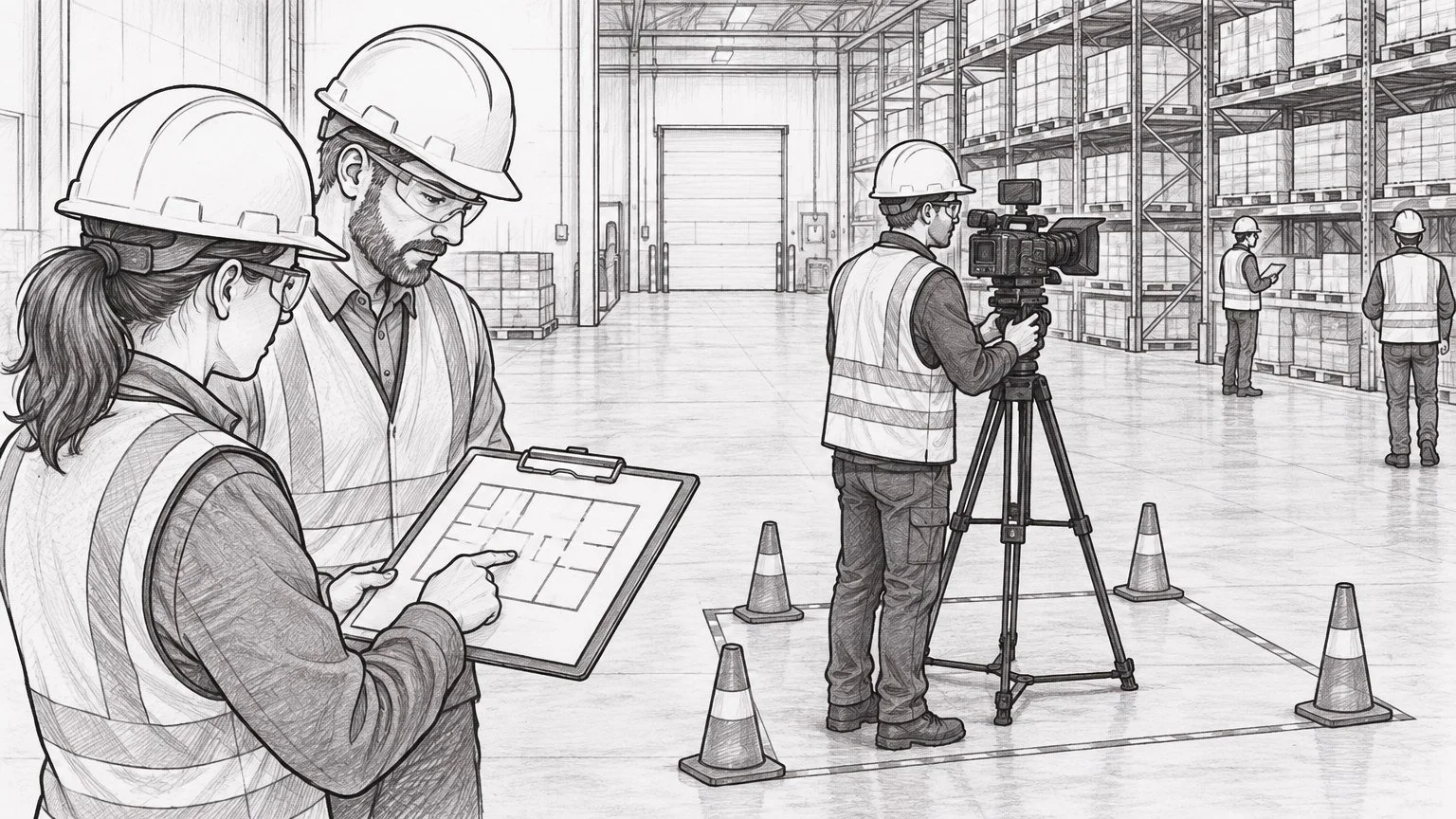
AI-generated storyboard illustration; a conceptual scene, not a client-production still.
Your warehouse, plant, or office is doing two jobs on shoot day: running the business and appearing on camera. The production schedule has to serve both. A beautiful shot is not a good trade for an interrupted process, a blocked route, or an employee being asked to improvise an unfamiliar task.
To film at a working facility without unnecessary disruption, agree on a written operating plan before the call sheet: what must keep running, where the crew can work, which activities need a protected filming window, and who can stop or change the setup. Build the story around approved operations—not the other way around.
For a marketing director commissioning Dallas commercial video production at an active site, the most valuable preparation is a conversation between the producer and the people responsible for the work. Marketing owns the message. Facility leadership owns operational permissions and site rules. The production team owns how its crew executes within them.
Start with what cannot stop—not with the shot list
A location scout asks whether a space can support a shoot. An operational plan asks whether that shoot can coexist with a normal working day. If you are still choosing a venue, use the location-versus-studio decision guide. Once the active facility is selected, make its operating constraints the starting point.
Ask the facility lead to identify the day's non-negotiables: deliveries, shift changes, customer access, production runs, maintenance, confidential meetings, and routes that must remain available. Include the people doing the work. A manager may approve a corner of the floor while an operator knows that it becomes a staging area every afternoon.
OSHA's hazard-identification guidance recommends collecting information about work areas and operations, involving workers, and considering nonroutine activities. Bringing a temporary film crew into a workplace deserves that site-specific conversation. A marketing checklist is not a substitute for the employer's safety procedures or a competent review of production-related hazards.
Translate those constraints into boundaries the crew can use. “Do not interrupt shipping” is vague. “No equipment or crew in the dispatch aisle; interview setup stays in the training room; the shipping supervisor approves any filming from the marked observation area” is actionable.
Divide coverage into three operating modes
Instead of treating every shot as equally available, ask the producer to classify it. This reveals which creative ideas depend on operational cooperation before the estimate and schedule harden.
1. Observe normal work
The camera records an approved activity from an approved position while the work continues normally. Employees follow their existing procedures. The crew does not ask for a repeat, a slower movement, or a different route without permission.
This approach can preserve authentic detail, but the director has less control over timing, backgrounds, and continuity. Plan coverage around that limitation. A wider view and a close detail captured at different moments may tell the story without repeating the entire process.
2. Use a protected filming window
A facility lead approves a specific place and time for a controlled setup. This might be an interview in a quiet room or a demonstration in an area released for filming. The window includes setup and removal—not just the time the camera records.
Treat the end of that window as a real handback deadline. If operations needs the area at ten, a take ending at ten is late when lights and stands still need to move.
3. Substitute another treatment
Some shots are not worth the intervention they require. Replace them with a safer approved viewpoint, an interview explanation, a controlled tabletop detail, or a separate demonstration planned with the appropriate site personnel.
Do not ask employees to bypass guards, alter PPE, recreate a hazardous condition, or perform unfamiliar work for a cleaner image. If the approved process does not fit the original storyboard, change the storyboard.
Build the schedule around zones and windows
Grouping shots by storyboard order often creates unnecessary movement. In an active facility, group them by access zone, available window, and equipment footprint. A company move across the building means more than carrying a camera: it can involve escorts, check-ins, cable management, and another handover with operations.
Have the producer distinguish crew call, ready-to-shoot, and area released back to operations. Those are different milestones. Specify where the crew stages cases and where equipment can wait without occupying working space.
For an illustrative warehouse shoot, the sequence might be an interview in a training room, observational coverage from an approved floor position, then product details in a separately cleared area. That is a planning example, not a universal schedule. The facility's actual workflow determines the order.
Also identify a fallback within each window. If an approved process is unavailable, the crew should know which independent shot it can capture next. Otherwise a short operational delay becomes a room full of people waiting for marketing to decide. Connect those dependencies to the broader commercial video production timeline.
Solve sound without asking the business to go silent
A facility can look excellent and be unusable for a sustained interview. Machinery, HVAC, dispatch announcements, and intermittent loading noise can break dialogue across takes. A microphone close to the speaker helps, but it cannot make every background sound disappear.
Ask the sound recordist or producer to assess the actual interview position while representative operations are running. An empty-room scout does not establish what the room sounds like during a shift.
The preferred fix is often separation: record the interview in a controlled room and use approved operational footage over the answer. You retain the real workplace as visual evidence without making the entire facility accommodate dialogue recording.
If a quiet period is essential, secure a specifically approved window with the facility lead. Never assume machinery, alarms, ventilation, or announcements can be switched off for sound. Changing an operational system is not a creative department decision.
Put employee time and sensitive information on the plan
“We only need them for a quick interview” is not a useful staffing request. Give supervisors an arrival time, expected involvement, release point, and contact for changes. Ask who covers the person's normal responsibility while they participate. Build a short preparation conversation into the plan rather than using camera time to discover what the employee is comfortable explaining.
Keep participation and permission separate from operational access. Coordinate the company's applicable appearance permissions and privacy process before filming identifiable people. Do not assume permission to enter the building grants permission to publish every person, screen, customer name, badge, or proprietary process in it.
Create no-camera zones and identify sensitive backgrounds during the walk-through. A monitor in the far corner can reveal more than the subject in the foreground. Preventing that exposure on set is better than discovering it in a finished edit, when blurring or replacement may damage the shot.
Name one client-side content reviewer who can flag these issues at practical checkpoints. That reviewer is not replacing the facility's safety lead or the director; the role is to catch business-sensitive details before the crew leaves.
Copy this active-site filming brief
Attach this brief to the production plan. Fill it jointly with the producer and facility contact; resolve blanks before the crew arrives.
Business objective: What must the audience understand, and which real operations provide evidence?
Operating priorities: What activities, deliveries, customer needs, and routes must remain unaffected?
Facility authority: Who approves locations and operating windows? Who is the backup during a shift change?
Zones and access: Where may crew, equipment, vehicles, and cases go? What requires an escort? What is off-camera?
Shot modes: Which shots observe normal work, which need protected windows, and which require a substitute treatment?
Site review: Who reviews the proposed activity, required induction and PPE, relevant hazards, and production equipment placement?
People: Which employees are participating, when are they needed, who covers their work, and what permissions apply?
Sound: Where will dialogue be recorded under representative conditions? What is the approved fallback if noise changes?
Sensitive material: Which screens, documents, processes, brands, and people cannot appear? Who checks them?
Window and handback: When can setup begin, when must shooting stop, and who accepts the cleared area?
Change and stop authority: Who can pause work, how does the crew contact them, and who approves a revised plan?
Scope consequence: If access disappears, which story elements remain essential, which can be exchanged, and who authorizes extra work?
Keep the brief practical. A named owner and a clear boundary beat a paragraph promising to “minimize disruption.” Use the production-company hiring questions to test whether a prospective partner can translate these answers into its crew and schedule.
Make the handback part of the shoot
Before moving to the next zone, have the responsible facility contact confirm that the area is ready to return to normal use. Account for equipment and materials, remove the production footprint, and report any issue through the site's process. Do not quietly leave a problem for the next shift.
Afterward, record what coverage was completed, what operations changed, and whether the remaining story still works. Missing a particular angle is not automatically a failed shoot. Missing an essential piece of evidence without telling the client is.
The decision to make before shoot day
Choose a production plan that can tell the story inside the facility's real boundaries. When an important shot cannot coexist with operations, approve a protected window or change the treatment before the crew arrives. A good active-site shoot leaves the marketing team with credible footage and the facility team with a workplace they can keep running.