Two production companies read the same brief. Both propose a cinematic brand film. Their estimates land nowhere near each other.
Before deciding that one is expensive and the other is a bargain, check whether they are pricing the same job.
To compare outdoor video production estimates, align the location assumptions, shoot schedule, weather plan, crew responsibilities, usage rights, and final deliverables first. Then compare the total. A lower number may reflect a simpler approach—or an important cost that has not been included yet.
For a Dallas–Fort Worth marketing team planning a ranch shoot, an equipment campaign, or an outdoor lifestyle film, that distinction matters. The location is part of the story. It is also a working environment, with its own access, safety, and scheduling requirements.
Here is a practical way to compare proposals without needing to become a producer yourself.
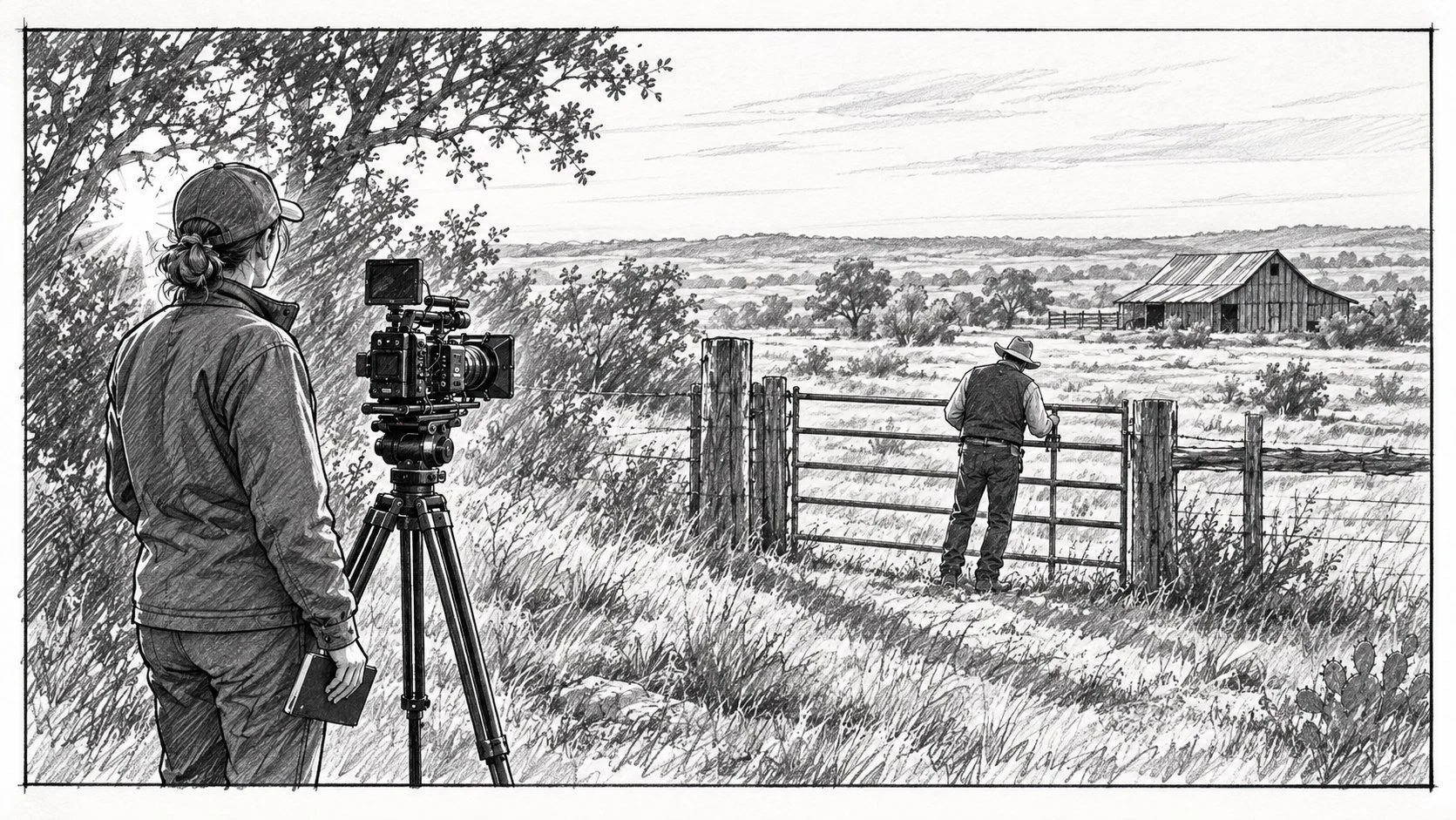
AI-generated storyboard illustration; a conceptual scene, not a client-production still.
1. Give every production company the same version of the job
“An outdoor brand video” leaves a lot open to interpretation. One team may picture a short interview with supporting footage. Another may picture several locations, cast talent, moving vehicles, and a full campaign of edits.
Start with a shared brief that names:
The audience and the one thing the film needs to communicate.
The product, person, or activity the audience needs to see as proof.
Required locations, participants, and filming dates.
Where the work will appear, including paid advertising.
The expected films, versions, and approval process.
The working budget range, if one has been established.
Ask each team to separate included work, optional additions, and unresolved assumptions. Otherwise, you are comparing different creative interpretations disguised as comparable totals.
For the broader cost categories, start with our guide to budgeting for video production. This checklist focuses on the assumptions that can make outdoor proposals diverge.
2. Compare usable location time—not just “one shoot day”
A ranch within driving distance of DFW and a remote property might both count as one location. They do not necessarily create the same workday.
Check how each estimate handles travel, unloading, vehicle access, equipment transport, setup, and moves between filming areas. Ask whether the quoted day includes travel time and what triggers overtime.
Then connect the schedule to the creative. If the film depends on sunrise, how will the team reach the location, prepare safely, and be ready before that light arrives? If the interview and product scenes sit on opposite ends of a property, where does that move fit?
Ask: “Can you walk us through the proposed day, including travel, setup, moves, and the light-dependent scenes?”
A schedule that works on paper should also work when everyone is carrying equipment through a gate.
The Yellowstone lesson: budget for the right light, not just more gear
Big productions do not buy their way out of the sun’s schedule.
In May 2023, IndieWire, citing The Wall Street Journal, reported a $12 million-per-episode budget for Yellowstone’s then-current season. That is a reported television budget—not a cost benchmark for a brand shoot.
The more useful detail comes from cinematographer Christina Alexandra Voros. In a 2022 interview about the show’s cinematography, she explained: “We pay a lot of attention to time of day and build around it more than I have on other projects.”
On Taylor Sheridan’s related series 1923, cinematographer Robert McLachlan described prioritizing exterior backlight at optimal times of day. Limited daylight created real pressure to capture the coverage a scene needed—not simply perfect each individual shot.
The lesson is not “never bring lights.” It is decide how the scene uses daylight before deciding what equipment it needs.
On an outdoor commercial, diffusion can soften direct sun, reflectors can redirect it, and black fabric can reduce reflected light—a technique called negative fill. A natural-looking image can still require people, equipment, and setup time.
For your commercial, ask: “Which shots depend on a specific sun position, and does this estimate protect the time to get them?” A scout and a realistic shooting order may be more valuable than an impressive equipment list.
3. Make weather a written decision, not an optimistic assumption
Outdoor production does not need perfect weather. It needs an agreed response to the weather that would prevent safe or usable filming.
One concept may benefit from overcast skies. Another may depend on dry ground, specific light, or a product demonstration that cannot happen in certain conditions.
Ask each team to explain:
What conditions would trigger a change or postponement.
Who makes that decision, and by what deadline.
Whether a backup date is reserved, available but unheld, or not included.
Which location, crew, equipment, travel, or talent charges could still apply.
What can be filmed instead if only part of the day becomes unusable.
A contingency allowance and a weather hold are not the same thing. An allowance sets aside money. A hold concerns availability, and its terms need to be clear. Neither automatically means a replacement shoot day is covered.
4. Ask who owns the work behind each crew line
A smaller crew can be exactly right for a quiet, observational film. A larger crew may be justified by simultaneous setups, lighting demands, vehicle work, or a complex schedule. Headcount alone does not tell you which approach fits.
Instead, ask who is responsible for directing participants, recording clean sound, managing the schedule, handling equipment, and protecting the footage. Understand where one person is carrying several responsibilities—and whether the schedule allows for that.
For real customers or ranch staff, leave room for preparation and conversation. People who do the work every day may bring credibility that a script cannot manufacture. That does not mean they will deliver their best story the moment a camera turns on.
For filming involving animals, machinery, or moving vehicles, ask how qualified operators, site coordination, and safety planning are addressed. A beautiful shot is not a reason to improvise around an avoidable risk.
5. Look for the unglamorous location costs
Some production expenses will never appear in the frame. They still help make the frame possible.
Depending on the property and scope, compare provisions for:
Location permission, fees, and any applicable permits.
Parking, site access, transport, and a place for the crew to stage equipment.
Power, restrooms, drinking water, meals, and appropriate shelter.
Travel, accommodation, and site-specific insurance requirements.
A location scout and coordination with the owner or operator.
Not every shoot needs every item. The important distinction is between not needed, provided by the client, and not yet priced.
If the brand is supplying access or facilities, put that responsibility in writing. “We have a ranch we can use” is a helpful starting point, not a complete location plan.
6. Compare the campaign deliverables, not just the hero film
Two estimates can promise the same finished runtime while including very different amounts of work.
A single landscape film is not the same deliverable as that film plus vertical adaptations, short paid-social edits, captions, alternate openings, and product-specific versions. Reframing an existing edit may be simple; rebuilding its pacing, graphics, and story for another placement may not be.
List each required version before the shoot. Include its intended channel, approximate length, aspect ratio, language, and whether it needs a distinct message or call to action.
Also clarify whether “stills” means frames pulled from the video or a separate photography assignment. Those are different plans, not interchangeable extras.
Our production FAQ outlines the wider creative-to-post process. The estimate should translate that process into the specific work your campaign needs.
7. Put rights and revisions beside the price
Check the intended usage for music, performers, voiceover, locations, and other licensed material. Specify channels, territory, duration, and whether paid media is involved. Confirm the permissions that apply to your project rather than assuming every asset can be used everywhere indefinitely.
Ask what “two rounds of revisions” means, too. Does each round require one consolidated response? What happens when an approved script changes after filming? Are extra versions treated as revisions or additional scope?
Finally, clarify the handoff. Finished films, raw footage, project files, and audio stems are different assets. Availability, ownership, storage, and reuse should be addressed in the agreement—not inferred from the fact that a camera was hired.
8. Use this side-by-side estimate worksheet
Copy these rows into a spreadsheet and ask each production company to fill the gaps.
Creative scope: Concept, scripting, interviews, and approvals included
Location and schedule: Scout, access, travel, working hours, moves, and overtime terms
Weather: Decision deadline, backup-date status, and postponement costs
Crew and equipment: Responsibilities covered and any conditional additions
Site support: Facilities, transport, permissions, and client-supplied items
Deliverables: Exact edits, versions, formats, captions, and stills
Rights and handoff: Usage limits, supplied assets, footage, and archive terms
Changes and payment: Revisions, scope-change approval, exclusions, and payment schedule
Mark each item included, excluded, conditional, or client-supplied. Ask for unknown amounts to be resolved before comparing the totals. Do not quietly enter zero for an unanswered question.
Where to simplify when the budget needs to come down
Reduce complexity before removing the work that makes the story understandable.
Try one location instead of several. Build around one strong participant rather than a large cast. Separate essential launch deliverables from optional versions. Ask the creative team which visual ideas carry the message and which are simply nice to have.
Be cautious about cutting interview sound, realistic setup time, or necessary safety provisions just to preserve another scenic shot. A film about craftsmanship needs more than beautiful scenery; it needs a person, an action, and a reason to care.
The best estimate makes the tradeoffs clear
A useful outdoor video production estimate tells you what will be made, how the production will work, what could change, and who owns each decision.
Before approving a proposal, ask one final question: “What are you assuming that we have not discussed yet?”
That conversation is often more useful than another round of negotiating the bottom line. Use this checklist with any production partner—and, if you want visual context for the kinds of commercial and branded films discussed here, explore Fragrant Film’s work.